PORTUGAL, 2016 Xavier and four other figures are highlighted in a special issue entitled Jesuits, Builders of Globalization: Father Antonio Vieira, St. John de Brito, Father Manuel Antunes, and Father Luis Archer.
Saint
Francis Xavier, SJ (1506-1552) page 3 of 3 |
PORTUGAL, 2016 Xavier and four other figures are highlighted in a special issue entitled Jesuits, Builders of Globalization: Father Antonio Vieira, St. John de Brito, Father Manuel Antunes, and Father Luis Archer.


PORTUGAL, 2016, postal card for the Holy Year of Mercy
showing Saint Francis Xavier preaching by André Reinoso (1610) from the collection of Museu de São Roque.
The imprinted stamp shows the Jubilee's logo designed by Fr. Marko Rupnik, SJ.

Spanish cinderella issued by the Mission Stamp Bureau in Madrid: "Collect
stamps for the missions"
This item was printed by Heraclio Fournier, SA, in Vitoria,
the Basque Country, Spain.
It is based on a painting at Xavier Castle by Brother Martín Coronas,
SJ.

Spanish label to raise money for the protection of minors.
After 1939, as a consequence of the Civil War disasters, La Junta Provincial de Protección de Menores en Valencia después de la Guerra Civil (The Committee for the Protection of Children) undertook its most important architectural project: El Grupo San Francisco Javier de Campanar (The San Francisco Javier Housing Estate). The San Francisco Javier Complex, located in the Camino de Tránsitos de Campanar, became a key example of the activity carried out by the Committee for the Protection of Children, and a paradigm of this type of child reformatory complex, consisting of isolated pavilions, church, gardens, and sport fields..

SAHRAWI ARAB DEMOCRATIC REPUBLIC (SADR), 1998, the xebec Javier,
from a set of 6 Sailing Ships
The xebec Javier was built by the Real Compañía Guipuzcoana
de Caracas after the plans of Manuel Antunez in 1756. It may be named for the
saint.

INDIA, 1964, the twelfth Exposition, November 25, 1964-January 5, 1965, held to coincide with the Eucharist Congress in Mumbai.
SPAIN, 8 July 1949, air mail special cancel, which coincides with the second Philatelic Exposition at Pamplona.


SPAIN, 1966 and 1967, show cancels, Xavier's arm &
Xavier preaching

SPAIN, 1987, this meter stamp from the Jesuit parish of St. Francis Borgia in Madrid shows
St. Francis Xavier on his deathbed.


AUSTRIA, 1990, show cancel (one of seven), for the 450th anniversary
of the Jesuits and the 500th of Ignatius' birth
PORTUGAL, 1991, 450th anniversary of Xavier's passing through
Setubal on his way to the East


ARGENTINA, 2001, special cancel, Saint Xavier's College (Colegio San Xavier) is a bi-lingual educational institution in Buenos Aires, comprising a kindergarten (founded in 1979), general basic bducation (6 years), and a middle school with intermediate and senior cycles. It is a secular school with a Catholic education, as evidenced by its name, chosen in honor of St. Francis Xavier.
ITALY, 2002, 450th anniversary of Xavier's death
SPAIN, 2002, special "Franqueo pagado" (postage paid) imprint used by the government of Navarre for the 450th anniversary of Xavier's death.


SPAIN, 2006, special cancels for the 500th anniversary of the
birth of Xavier,
celebrated with stamp expositions at Oviedo in December, and at the
Xavier castle in Spain in April/May and November/December
showing his portraits by Murillo and Salaverría.
PORTUGAL, 2006, the 5th centenary of Xavier's birth


SPAIN, 2006, special cancels for the 500th anniversary of the
birth of Xavier,
celebrated with a stamp exposition at the Xavier castle in Spain in
November/December
showing his portrait his castle and his death (after a painting by
Goya)


SPAIN, 7 November 2006, FDI cancels for the 5th centenary of
Xavier's birth
from Madrid (based on Salaverría's portrait) and Javier-Navarra
(based on Murillo's St. Francis Xavier as a Pilgrim).


SPAIN, 3 December 2006, the feast of St. Francis Xavier, special
Jubilee cancels
from Bergara (Vergara in Spanish), in the Basque Country province
of Gipuzkoa based on the Salaverría portrait


ITALY, 2006, FDI cancel to go with Jubilee issue from Rome
ITALY, 2006, show cancel from Cantù to go with the Jubilee issue
JAPAN, 2006, "18.2.17" means February 17, in the 18th year
of Heisei (the era of the current Emperor of Japan) or 2006 AD
special cancel said to honor the Xavier Jubilee showing the ruins of the castle
of Funai and a statue of Xavier preaching
(though obviously it had been used earlier on December 12, 2000)
The second line of Japanese characters is "Sabiru" (Xavier) in katakana
INDIA, 3 December 2006, special cancel for the 5th centenary of Xavier's
birth

INDIA, 2015, special cancel for the Xavier Exposition Goa Pex
Xavier on statues


PORTUGAL, 1940, Monumento a los Descubrimientos (Xavier is the second figure from the right, kneeling, hands joined and the cross on his breast), Scott 589, 593Xavier appears subtly in sculpture on stamps. On the statuary of the Charles Bridge in Prague, on the plague columns illustrated below, and on the Monument of Discoveries. The monument by the architect Cottinelli Telmo and the sculptor Leopoldo Almeida was erected for the first time in 1940, temporarily, as it was for the Exhibition of the Portuguese World. It was permanently installed in 1960, for the centennial of the death of Don Henry the Navigator, who appears in the prow of the monument.
Xavier as a Patron Saint for Protection Against the Plague

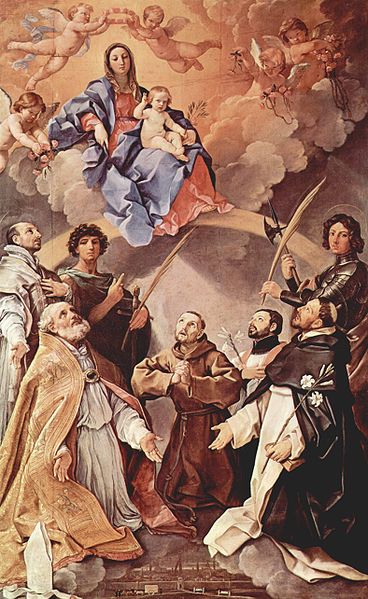
NIUE, Christmas of 1993, Scott 665
The above stamp is based on Guido Reni's Madonna of the Rosary, a pallione del voto or processional banner to protect Bologna from plague. Reni portrayed seven saint protectors of the town, including Xavier, shown to the left of St. Dominic, even though Xavier had only been canonized a few years at the time of the painting.
Dr. Walter Nissel and Wilhelm Remeš remind us in Die Jesuiten in der Philatelie that a number of plague columns have been erected in honor of the Trinity or of Mary to give thanks for deliverance from the plague. These columns, some of which have been depicted on stamps, contain images of saints especially regarded as protectors against the plague, St. Francis Xavier prominent among them.


CZECHOSLOVAKIA, 1946, the Marian column in Hodonin built in 1716,
Scott 317
CZECH REPUBLIC, 2008, the Marian column in Hradec Králové
with a bas relief of Xavier, Scott 3380
CZECHOSLOVAKIA, 1967, the Marian column in Jihlava built in 1690,
Scott 1443


AUSTRIA, 1982, the Trinity column in Langenlois built in 1713,
Scott 1214
CZECHOSLOVAKIA, 1957, the Marian column in Moravska Trebova built
in 1717, Scott 790


CZECHOSLOVAKIA, 1936, the Trinity column in Olomouc, Scott 225
SLOVAKIA, 1939, Scott 22
BOHEMIA & MORAVIA, 1939, Scott 18
This is a Karl Seizinger engraving which, like that
of Boscovich, he signed with a hidden S.


BOHEMIA & MORAVIA, 1939, the Trinity column in Olomouc built
in 1716, Scott 33-34


CZECHOSLOVAKIA, 1955, the Trinity column in Olomouc, Scott C41
CZECH REPUBLIC, 2002, The CZECHOSLOVAKIA, 1955, the Trinity column in Olomouc, Scott C41, Scott 3178
UNITED NATIONS, 2016, the Trinity column in Olomouc inscribed on the World Heritage list in 2000. It is the largest cluster of Baroque statues in one group in the whole of Central Europe.

SLOVAKIA, 1998, the Trinity column in Trnava from 1695, with
Xavier its left most figure
and the Jesuit Church of the Holy Trinity to the far left, Scott 221
Named for Xavier


CZECHOSLOVAKIA, 1936, the cathedral of St. Francis Xavier in Banská
Bystrica, Slovak Republic
part of the cathedral is seen at the extreme right of the vignette,
Scott 219,
overprinted B.I.T. 1937 for the International Labor Bureau issue, Scott
237
SLOVAKIA, 1939, the cathedral of St. Francis Xavier, overprinted
for Slovakia, Scott 14
Adolph Hitler declared the establishment of the independent Slovak Republic
on 14 March 1939;
BOHEMIA & MORAVIA, 1939, the cathedral of St.
Francis Xavier in Banská Bystrica, Scott 12
On 15 March 1939 Hitler established the Protectorate of Bohemia and Moravia
as autonomous Nazi-administered territories belonging to the Greater German
Reich.


SLOVAKIA, 1998, issued on September 11, 1998, this postal card celebrates
Finex '98;
it shows the twin towers of the church named for Xavier in Banská
Bystrica [issue number CDV 030 023/98, 5000 issued]
CZECHOSLOVAKIA, 1945, the cathedral
of St. Francis Xavier to the right of the clock tower, Scott
289


GABON, 1982, the church of St. Francis Xavier at Lambaréné, Gabon, Scott 526
BAHAMAS, 1982, the cathedral of St. Francis Xavier, Nassau, Scott 526
BAHAMAS, 2009, the cathedral of St. Francis Xavier, Nassau (new main entry), Scott 1291
NICARAGUA, 1988, St. Francis Xavier Church in Ciudad Sandino, is commemorated as one of the place from which the underground press , Periodismo de Catacumbas, operated.The foundation stone of St. Francis Xavier Church on West Hill Street in Nassau in the Bahamas was laid in 1885 under the supervision of the resident priest, Father O'Keefe. The church was consecrated by the Archbishop of New York Michael A. Corrigan in 1887. This is the Roman Catholic cathedral of the Archdiocese of Nassau and the oldest Roman Catholic church on the island.


CANADA, 2003, centenary of St. Francis
Xavier University in Antigonish, Nova Scotia, Scott 1975 and
its FDI cancel


MACAO, 2006, Calçada de S. Francisco Xavier, Scott 1199c
BOLIVIA, 2008 Universidad San Francisco Xavier, a
public university in Sucre, Scott 1383
FIJI, 2014 a Christmas issue shows the church of St. Francis Xavier in Navunibitu, Scott 1323
The Streets of Macao issue includes a stamp featuring St. Francis Xavier Steep Path (Calçada de S. Francisco Xavier).This street was inscribed with others on the World Heritage List as The Historic Center of Macao in 2005. St. Francis Xavier Steep Path, also known as St. Paul Steep Path (Calçada de S. Paulo), is situated between St. Paul Street (Rua de S. Paulo) and the Ruins of St. Paul's facade.

MACAO, 2003, the Chapel of St. Francis Xavier on Coloane Island
The chapel of St. Francis Xavier on Coloane Island is a small chapel built in 1928 following the Baroque style of Macao's major churches. It was used to house a number of sacred relics of Catholic Asia: a bone from the arm of St. Francis Xavier, bones of the Japanese martyrs, and relics of martyrs from 17th-century Vietnam. These relics have since been moved to the Seminary of St. Joseph and to the Sacred Art Museum. The chapel is used today as the parish church of the island and continues to attract pilgrims especially Japanese Christians.

INDIA, 2013, St. Xavier's College, Mapusa, Goa, special cover for
their 50th anniversary
Not a Jesuit school as such, though St. Xavier's has had individual Jesuits
working there.
MALAYSIA, 2016, a Places of Worship issue includes the Church of St. Francis Xavier (in Malay: Gereja St. Francis Xavier) in Malacca City, Malacca, Malaysia.


SPAIN, 1982 and 1991, postmarks from Javier, Navarra
site of the Xavier castle, the birth place of Francis Xavier
SPAIN, 2006, postmark from San Javier in Murcia


SPAIN, 1973, postmark from San Javier for the 20th World Military Aeronautical Pentathlon Championship
at the Murcia-San Javier Airport in San Javier, which is primarily military and the home the the Spanish Aeronautical School.
SPAIN, 1976, postmark from San Javier for the 9th Parachuting Championship of the CISM (Conseil International de Sport Militaire) at the Murcia-San Javier Airport in San Javier, which is primarily military and the home the the Spanish Aeronautical School.
SPAIN, 1989, in the center the frank of the District Court of San Javier (Murcia)
San Javier, Spain, with a population just over 20,000, is a municipality in the Autonomous Community of Murcia, very near the border with Alicante province, just off the coast of the Mar Menor. It is the location of the San Javier International Airport, a military air base and passenger facility.

SPAIN, postmarked April 7, 2006, the 500th anniversary of the birth of Francis Xavier from "Sangüesa Javier"
a combination postmark since the town of Sangüesa is about 5 miles from the village and castle of Javier
SPAIN, postmarked 24 March 2011 San Francesc Xavier is the capital of the island of Formentera in the Balearic Islands; the main church, constructed between 1726 and 1738, is also dedicated to Francis Xavier, and until 1830 lodged canon to protect against pirates.


ARGENTINA, 1922, postmark from San Javier, Misiones
Province
ARGENTINA, 2006, postmark from San
Javier, Santa Fe Province
ARGENTINA, 2006, cancel from the municipality of San
Javier y Yacanto, Cordoba
CHILE, 1892, postmark from San
Javier, Chile in the Region of Maule
San Javier in the Misiones Province in northeastern Argentina is the capital of the Department of San Javier in that Province. Jesuits founded this San Javier in 1743 as a reduction in the land of the Mocovíes Indians on the banks of the San Javier River in Santa Fe Province (SF). Argentina also has a San Javier Department in the Cordoba and Santa Fe Provinces.
San Javier and Yacanto, also in Argentina. is result of the division of the estancia of Yacanto, at the end of the 17th century. Situated in the valley of Traslasierra, at the foot of Champaquí Mountain (2.880 m.) in the Comechingones range, it originated around the chapel of San Francisco Javier of Yacanto.
San Javier, Chile, is a city of 20,000 people located in the wine country.

CANADA, 1993 postmark from St. François Xavier, Manitoba, Canada


UNITED STATES OF AMERICA, 1954, postmark from the discontinued PO at St. Mary's University named Xavier, Kansas in honor of the saint.
UNITED STATES OF AMERICA, 2005, postmark from St. Xavier, Montana
URUGUAY, 2006, postmark from San Javier, Uruguay.San Javier, Uruguay is a town with many Russian emigrants in the Río Negro department. It was founded in 1913, Uruguay's first agricultural colony, by Russians in search of greater religious freedom. It was here the Uruguayan military executed Vladimir Roslik, now a national hero. St. Xavier, Montana was officially established as the first mission for the Crow Indians in 1887 by Jesuit missionary, Fr. Peter Paul Prando, SJ (died 1906). The church, dedicated to St. Francis Xavier, is still in use and the school, affiliated with the St. Labre Mission School, also continues to operate.