Spanish Jesuit Mission to India
In 1947 this cinderella was issued to commemorate the 25th anniversary of evangelization by Spanish Jesuit missionaries in Bombay and Ahmedabad (India) which had begun in 1922. The Ahmedabad mission was such a success that two years after this cinderella was issued the Ahmedabad Diocese was formed on May 5, 1949, the first Bishop of Ahmedabad being the Karachi-born Jesuit Edwin Pinto, SJ (1901-1978). One of the missionaries arriving in Bombay in 1922 was Fr. Henry Heras, SJ who was appointed to teach history at St. Xavier's College, Bombay (Mumbai).

Our Lady of Good Health Church, Ariankuppam


INDIA, 2015, Special cover and cancel for the 325th anniversary of
Our Lady of Good Health Church
The Church of our Lady of Good Health is located in Ariankuppam, a village 4 km south of Puducherry (formerly known as Pondicherry). After the French arrived in Pondicherry in 1673, Armenians under the leadership of Bishop Adda Simon built the Church of Our Lady of Conception in 1690. This church was given to the Jesuits of the Carnatic Mission (as the move from Pondicherry to the northwest toward the territory known as the Carnatic was then called) around 1700 and the church was renamed Church of Our Lady of Health, and remained in their care until the Suppression. It has been a very popular pilgrimage amongst the people of Pondicherry for the last 270 years. The superior of Pondicherry Mission at the beginning of the 18th century and the founder of the Carnatic mission was Fr. Guy Tachard, SJ, pictured elsewhere in this collection.
St. Stanislaus High School, Bandra


INDIA, 2013, special cover and cancel for the 150th anniversary of
St. Stanislaus High School
German Jesuit missionaries laid the foundation of Jesuit education in St. Stanislaus. It began as an orphanage in 1863, housing 140 native orphans under the stewardship of Fr. Joseph Weber. One large square building (the old St. Peter Church) contained a study hall, refectory, classrooms, and a couple of rooms for the fathers. Over the years new land and buildings were added. After World War I, the Spanish Jesuits took over from the Germans. The school, which started as a primary institution, got its status of a high school in 1925 – 26. In the early 70’s the dormitories were closed and converted into classrooms for day scholars. Today the St. Stanislaus School building in its majestic green and yellow colors occupies an area of 59,556 sq. ft. It overlooks two playgrounds of 3555 square feet each, and has around 2200 students.
St. Joseph's Boys' High School, Bangalore


INDIA, 2008, the 150th anniversary of the school, its FDI cover and
cancel, Scott 2274
St. Joseph's Boys' High School, Bangalore was founded in 1858 originally to educate European and Anglo-Indian boys. After India's Independence, admission was extended to all nationalities and religions. In 1854 Bishop Clément Bonnard and the priests of the Missions Étrangères de Paris (MEP) founded a school, St. Joseph Seminary, and an orphanage at St. John's Hill, Bangalore. When the University of Madras was established in 1858, the fathers at St. Joseph decided to open a school for European boys. By 1875 the orphanage was moved and the seminary closed. After the First World War it became difficult for the French fathers, depleted by the war, to continue to send priests to the school. The Bishop of Mysore, Maurice-Bernard-Benoit-Joseph Despatures, MEP, invited the Italian Jesuits of Venice to take over the school, which they did in 1937. The Indian Jesuits of Karnataka eventually took it over and under their direction it developed into two separate institutions: St. Joseph's University and St. Joseph's College (see below).
St. Joseph's College, Bangalore

INDIA, 1982, special cover and cancel for the school's centenary


St. Joseph's College in Bangalore is an autonomous Jesuit institution affiliated to Bangalore University. It is one of a number of interrelated sister institutions, including also St. Joseph's College of Commerce, the St. Joseph's Evening College, the St. Joseph's Boys' High School (see above) and the St. Joseph's Indian High School. The college was founded in 1882 by the fathers of the French Foreign Mission, and on 1 June 1937 was handed over to the Society of Jesus, which has run it ever since. The stamp was issued to honor the school for its 127 years of service.
Loyola College, Chennai
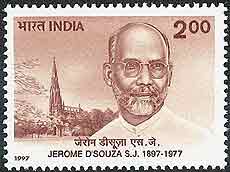


INDIA, 1997, the centenary of the birth of Fr. Jerome D'Souza, SJ,
Scott 166
and its FDI cancel featuring the coat of arms of Loyola College, Chennai
When the life of Fr. Jerome D'Souza, SJ was celebrated with the above issue, included in the background of the stamp was the church of Loyola College in Chennai (formerly Madras), the Jesuit school where Fr. D'Souza had long worked.
St. Joseph's School, Darjeeling


INDIA, 2013. India celebrated the 125th anniversary of St. Joseph's School in Darjeeling with a special cancel.
The building is portrayed on this special cover.
St. Joseph's School is popularly known as North Point because it is situated in that area of Darjeeling. The school opened on February 13, 1888, at Sunny Bank in Darjeeling. There were eighteen boarders and seven day scholars on the rolls. Numbers increased and the need was felt for more ample grounds. Property was procured by Fr. Henri Depelchin SJ, the founder, on the town limits at North Point. The foundation stone was laid on April 27, 1890, and on February 18, 1892 the new building received the first North Pointers. In 1899, the student body consisted of 193 boys. Towards the end of 1908, Sir Andrew Fraser gave money that was used to close in the quadrangle completely. With this the number of students increased to 290. In 1947, the year of Indian Independence, the number reached 422, including ninety-three college students. The school became more international and by 1954, twenty-eight nationalities could be found in the college. Initially, Belgian Jesuits ran the school but in the late 1940s, the Canadians took over, though at present there is just one Canadian priest on staff. "The Harrow of the East," its alumni include the royal families of Nepal, Bhutan, Coochbehar, Burdwan, and nephews of the former Shah of Iran.
The Basilica of Bom Jesus & the Professed House, Goa

PORTUGUESE INDIA, 1931, from the Xavier issue, Scott 418
the Jesuit
Basilica of Bom Jesus and next to it the former professed house (Jesuit
residence)

PORTUGUESE INDIA, 1946, a postal card featuring the interior of the
Bom Gesu Church, H&G 42a
its stamp bears the image of St. John de Brito

INDIA, 2011, from personalized sheet for the World Philatelic Exposition,
New Delhi, 12-18 February, shows the Bom Gesu Church
Saint Xavier's School, Jaipur

INDIA, 2002, special cancel for the 450th anniversary of Xavier's death
featuring the Jesuit secondary school in Jaipur, St. Xavier's School


INDIA, 1985, the 125th anniversary of St.
Xavier's College in Kolkata, Scott 1087 and its FDI cover and cancel
Fr. Henri Depelchin, SJ (1822-1900) came with an Anglo-Belgian group to Calcutta (now Kolkata) in 1859 to start St. Xavier's College there. He had become its rector in 1864. By the end of his tenure in 1871 the school had 500 students, and Fr. Depelchin moved on to be rector at St. Xavier's in Mumbai. After a failed attempt to establish a mission in the Zambezi River Valley in the 1880s he returned to spend the rest of his life back in India. Rabindranath Tagore, Jagadish Chandra Bose and Ramananda Chatterjee are counted among the alumni of St. Xavier's in Kolkata.
St. Aloysius College, Mangalore


INDIA, January 12, 2001 — the day in 1880 that St. Aloysius College
began, Scott 1870,
and its FDI cover and cancel featuring the college's coat of arms
St. Aloysius College Chapel in Mangalore is decorated by the paintings — frescoes, tempera and canvas panels — of an Italian Jesuit, Brother Antonio Moscheni, done from 1899 to 1901. The above panel shows the early life of St. Aloysius, patron of youth, for whom the school is named.
Doot, Mumbai
(1911-2011)
INDIA, 2011, the centennial of the founding of Doot, and its FDI cover and cancel, Scott 2484The magazine, Doot (Messenger), which has completed a centenary of uninterrupted publication, has contributed to bringing many words spoken in Central Gujarat to the main stream and to the Gujarati dictionary. Jesuit Father Herman Zurhansen of Germany started the magazine in Gujarati with only 12 pages. The first issue came out in January 1911 and was printed at the Examiner Press, Mumbai. It was initially named as "Ati Pavitra Antakaranno Doot" (Messenger of the Sacred Heart) which was in 2000 shortened to the present name: Doot. Editors from different countries such as Switzerland, Spain and Germany took charge of the magazine during its last 100 years. Jesuit Father Basil Lala Parmar was the first Indian editor of the magazine from February 1956 to June 1969.


INDIA , 1994, the 125th anniversary of the founding
of St. Xavier's College, Mumbai (Bombay),
Scott 1513, and its FDI cover and cancel
St. Xavier's College, Palayamkottai

INDIA, 1999, special cover and cancel for St. Xavier's College in Palayamkottai;
for various reasons Palayamkottai is spelled with either an n or an m both of which appear in the cancel.St. Xavier's College, Palayamkottai is a Jesuit College of Arts and Sciences affiliated with Manonmaniam Sundaranar University, Tamil Nadu, India. The school was founded in 1923, by Fr. Albert Lebeau, SJ, who was born in Belgium, the help and cooperation of Fr. Causannel, SJ, Fr. Dhanasamy, SJ, and Fr. A. Gnanapragasam, SJ, who also played a leading roles in the founding and the early development of the college. Fr. Lebeau was appointed as the first principal and he successfully led the college from 1923 to 1926.

St. Xavier's School, Gandhi Maidan, Patna


INDIA, 2007, a special cover for St. Xavier's High School in Patna
bears a cancel
that celebrated the triple jubilees in 2006 of St. Ignatius, St. Francis Xavier,
and St. Peter Faber.
St. Xavier's High School, Patna was established by Fr. Frank Loesch, SJ, assisted in this task by Fr. Marshall D. Moran, SJ, from the American Chicago Province of the Society of Jesus. Unlike existing schools the new school in Patna was to be for Indians of all castes and creeds. St. Xavier's High School opened on 17 January 1940 with Fr. Moran as its first principal. Fr. Moran later crossed into Nepal to become the first Jesuit priest to enter the country in over 200 years, and was invited by the Nepalese Government to open a Jesuit school in Nepal—St. Xavier's School, Godavari, Nepa—in 1951. There are three school buildings at Patna, one for the kindergarten (two-storied), second for the primary school (five-storied) and the third for the secondary school (three-storied).


SRI LANKA, 2005, 50th anniversary of the National
Seminary of Our Lady of Lanka,
the original home of the Papal Seminary at Pune, Scott 1519
INDIA, 1993, the centenary of the Papal Seminary at Pune, Scott 1465 and
its FDI cover and cancel
Pope Leo XIII asked the apostolic delegate for India and Ceylon, Archbishop Ladislaus Zaleski, to establish a seminary for the training of priests in India. Zaleski entrusted the work to the Jesuits and to Fr. Sylvain Grosjean, SJ, one time superior of the Jesuits' Bengal Mission. In 1893 the future Papal Seminary began in rented facilities in Ampitiya, Kandy, Sri Lanka, and moved to new and larger quarters in 1909. In 1926, the same year the seminary chapel was completed, it was authorized by Rome to confer degrees in philosophy and theology. After Sri Lanka gained national independence, a decision was made to move the seminary. In 1955, still under Jesuit auspices, it was transferred to Pune in India. The old buildings at Ampitiya, shown on the Sri Lankan stamp (above), became the National Seminary of Our Lady of Lanka entrusted to the Oblates for the training of Sri Lankan clergy.
St. Anne Church, Talaulim

INDIA, 2009, Heritage Monuments Preservation issue: mini-sheet, stamp, FDC and cancel, Scott 2308cSt. Anne Church in Talaulim seems to have been of Jesuit foundation. In 1577 a piece of land was offered to Jesuit priest was preaching in Talaulim and nearby Gualim-Moula, who began constructing a small chapel there, but had not decided which saint to dedicated it to. A villager, Bartolomeu Marchona, told the priest he had met a old woman with a hat and walking stick who claimed the church was hers and that she wished to stay there. A Brahmin woman dreamed at the same time of an old woman named Ana who wanted a place to stay. The Jesuit decided the old woman was St. Anne (Ana), mother of the Blessed Virgin, and dedicated the church to her. The church was extended by Msgr. Francisco de Rego from 1681 to 1689 and completed by Fr. Antonio Francisco da Cunha in 1695. Because of the church, the locale today is often called Santana rather than Talaulim.
Loyola School, Thiruvananthapuram
INDIA, 2011, special cover and cancel for the 50th anniversary of the schoolLoyola School, Thiruvananthapuram is a private Jesuit school for boys situated in a large, leafy campus in the suburb of Sreekariyam in Thiruvananthapuram (formerly, Trivandrum) city, in the Indian state of Kerala. The school serves students from upper kindergarten to higher secondary level. Students of Loyola are called Loyolites. Founded in 1961, Loyola is owned by the Kerala province of the Society of Jesus. The nominal head of the school has always been a Jesuit priest with the title of Rector. The executive head of the school has always been a Jesuit priest with the title of Principal. The principal manages the day-to-day activities of the school. Both of these report to the provincial of the Kerala Jesuit province. Loyola has been affiliated to the Council for the Indian School Certificate Examinations, New Delhi since its founding. Initially, the school offered only the higher secondary level Indian School Certificate, recognized by University of Kerala and many Indian universities for admission to university studies.
Basilica of Our Lady of the Snows, Tuticorin
INDIA, 2007, the 425th anniversary of the church's dedication, and its FDI and cancel, Scott 2227According to one tradition Francis Xavier had seen a statue of Our Lady of the Snows in Manila in a aonvent of the Augustinian Sisters and had asked that it be sent to the newly converted Paravars of the Pearl Fishery Coast to be honored in place of the Hindu Goddesses they had once been attached to. The sisters at first declined, but after Xavier's death, they sent it on the ship Santalena which arrived in India on 9 June 1555. The vicar general of the Goa Diocese, Michael Vaz, enshrined it in the Jesuit church of Saint Paul on Keracope Street in Thoothukudi, in the Diocese of Tuticorin, Tamil Nadu. On 5 August 1582 (the feast of Our Lady of the Snows) a new Jesuit church was dedicated by the Bishop of Cochin to house the statue. Dedicated first under the title of Our Lady of Mercy, because of the the miraculous statue, it came to be known as the Church of Our Lady of the Snows. In 1658 the Dutch captured Tuticorin, forced the Jesuits out, and in 1695 destroyed the church. Fr. Vigilius Mansi, SJ, who kept the miraculous statue in his possession, built the present structure in 1713. After the Suppression in 1773 priests from Goa diocese took charge of the church. When the church was celebrating the 400th anniversary of the original dedication in 1582, Pope John Paul II raised it to the status of a basilica.


