
The Pietà
By Fr. Peter Fennessy, SJ
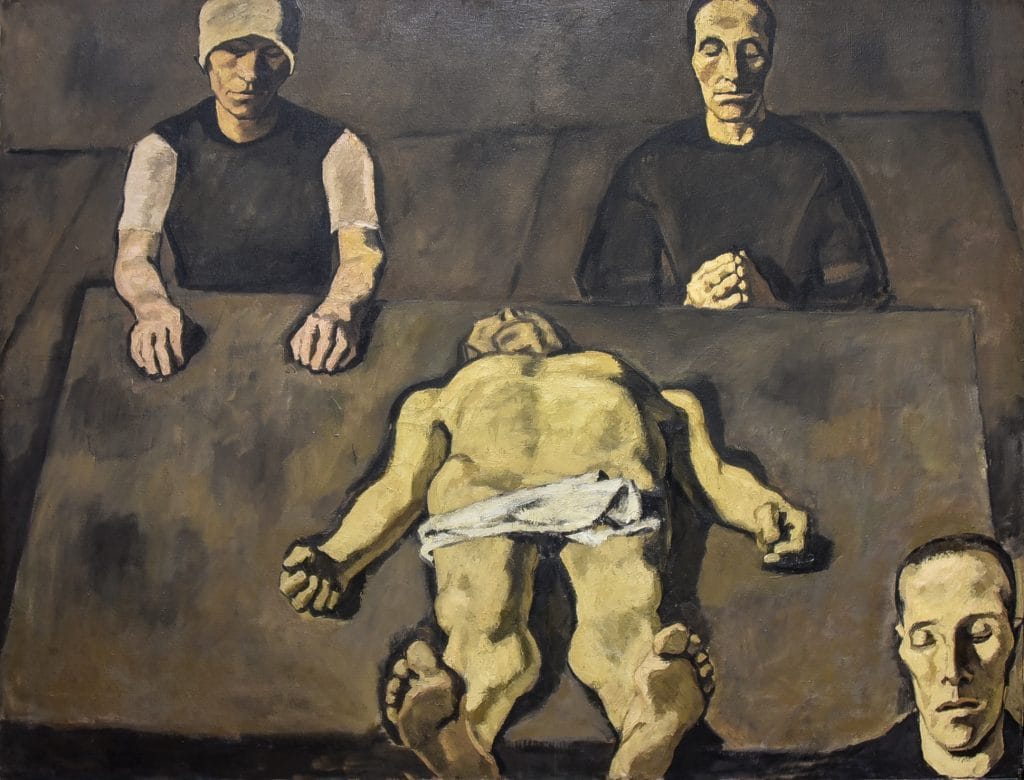
Albin Egger-Lienz, Pietà (1926), oil on canvas, 68.1 × 90.9 inches, The Leopold Museum, Vienna, Austria.
Its orientation recalls Mantegna’s “Lamentation of Christ.” Egger-Lienz’s mourners are less distraught than Mantegna’s, but they’re well acquainted with grief, and their mourning is the more moving for being solemn and silent. This woundless body might represent any death in the peasant community; these mourners might stand for all who mourn. The empty place in the lower left invites us to enter the scene as a fourth mourner.
Egger-Lienz’s “The Dead Christ” (1926) is an almost exact copy of this painting without the mourners, as if He were lying in the tomb. “Pietà” focuses on sorrow; “The Dead Christ” focuses on the silence of the tomb.
On Holy Saturday we grieve with Mary and the disciples, or we rest with Christ and so may say with Paul Claudel, “With you I have descended into the tomb, and have lain there without motion, and the confines of your tomb have become the confines of my universe.”
