Reflections on Art from 100 Years Ago

Christ and the Sinner

By Fr. Peter Fennessy, SJ
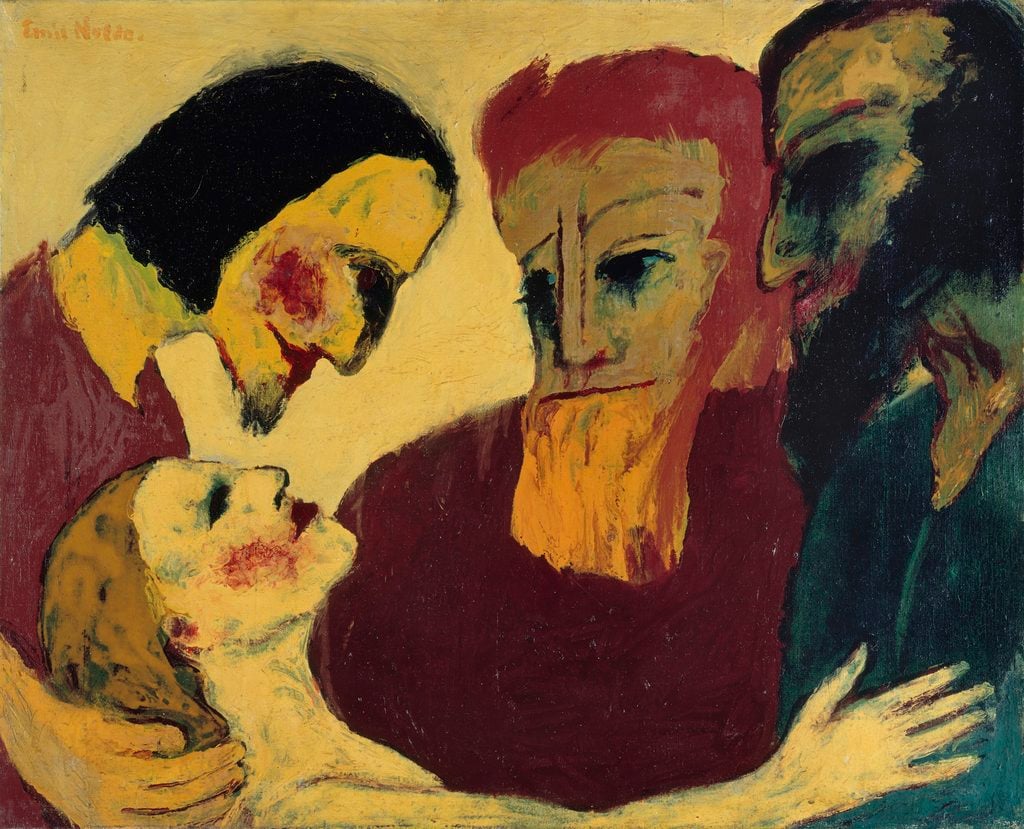
Emil Nolde, Christ and the Sinner (1926),
oil on canvas, 33.9 × 41.8 inches, New National Gallery, Berlin.

Emil Nolde’s bold colors and exaggerated features in “Christ and the Sinner” (1926) add intense emotionality to this painting. The Nazis considered it degenerate; art critics and historians call it Expressionism. It portrays a sinful woman who washed the feet of Jesus or “The Woman Taken in Adultery,” the title of the etching this work was based on. Without a contextual background the reference is ambiguous. Did Nolde use this ambiguity to unite the two stories?

The Pharisees had brought Jesus a woman caught in adultery (John 8:3-11). The Law decreed she should be stoned to death. What did He say? Whether Jesus contradicted the Scriptures or His own constant message of mercy, they had Him. The Law actually said “the couple” should be stoned, but the Pharisees let the man get away, because they had less concern for the Law than for trapping Jesus. Jesus escaped their trap, shamed them into fleeing and didn’t condemn the woman. Later realizing she had been forgiven, she came to Jesus and washed his feet with tears of gratitude (Luke 7:36-50). Christ’ parable of the two debtors clearly indicates the forgiveness had produced her show of love, and not the other way around.
Reflections on Art from 100 Years Ago

The Prodigal Son

By Fr. Peter Fennessy, SJ

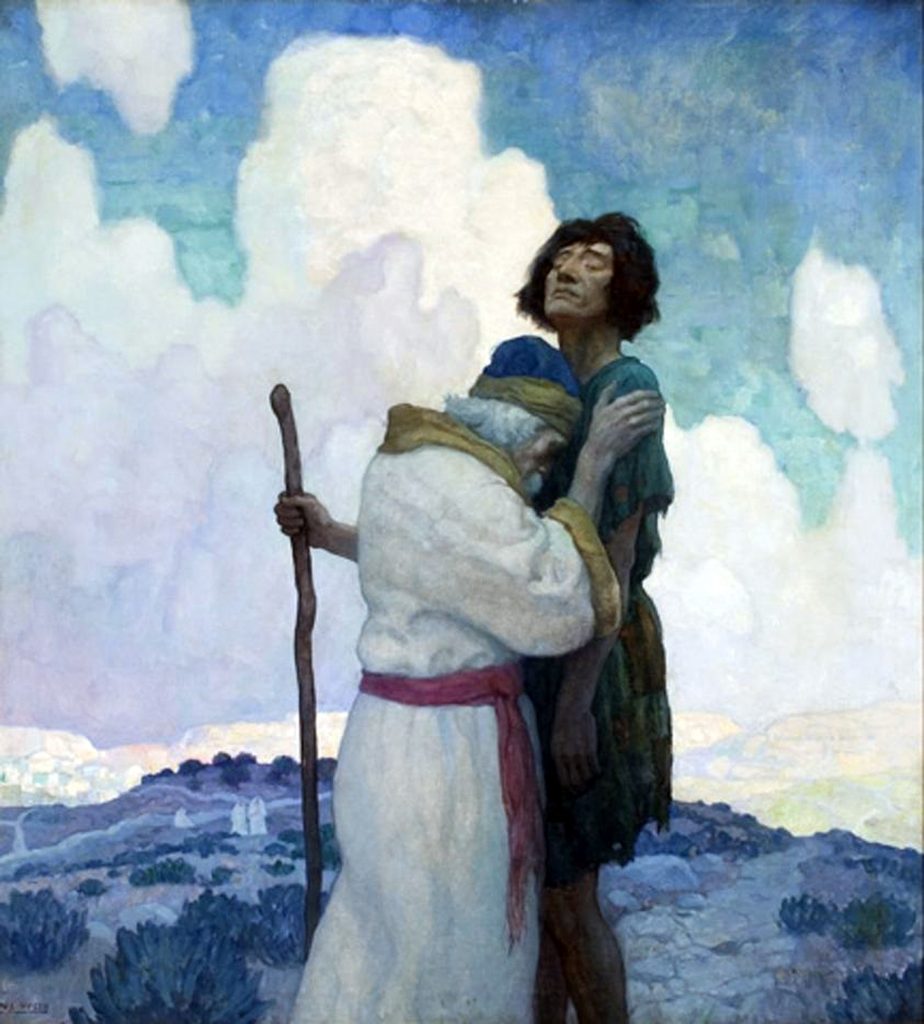
N. C. Wyeth, The Prodigal Son (c. 1926-1927),
oil on canvas, 45 × 40 inches, Kirk in the Hills, Bloomfield Hills, Michigan.

Most paintings of the prodigal son portray him embracing his father or kneeling before him, almost always with a bent head. Wyeth has unusually portrayed him with his head held high and drawn away from his father. One hand holds his walking stick and the other hand hangs by his side. He doesn’t dare return his father’s embrace. His original demand for his inheritance with its implied “wish you were dead” was an unspeakable and unforgiveable offence. His father should have declared him dead, sat shiva for him and even now have sent his servants to drive him away. His repentance arose more from hunger than sorrow, and he’s aware he doesn’t deserve acceptance even as a hired man, paid each day for his daily work, an outsider and less a part of the family than its slaves.

But his father had been watching the road, and seeing his son returning, he threw propriety to the wind, ran to the boy, embraced him and kissed him. The love and mercy, forgiveness and acceptance that the prodigal undeservedly met shamed him more than he can stand. It will take some time for him “to learn to bear the beams of love.”

Reflections on Art from 100 Years Ago

The Annunciation of the Virgin Mary

By Fr. Peter Fennessy, SJ

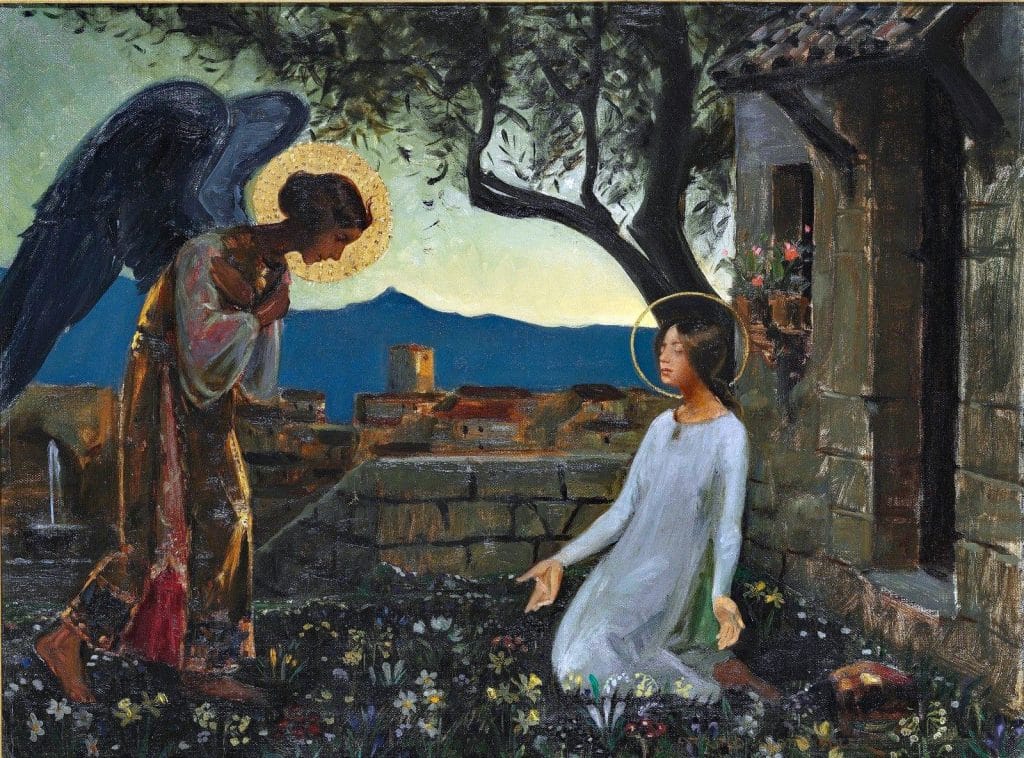
Harald Slott-Møller, The Annunciation of the Virgin Mary (1926), oil on canvas, 19.3 × 25.6 inches, private collection.

We celebrate today the Annunciation to the Virgin Mary (the earliest feast dedicated to her) and the Incarnation of the Lord, since the Word became flesh when Mary gave her consent. The abundant flowers denote new life and fecundity as well as purity. Today’s Gospel tells the story (Luke 1:26-38). And Harald Slott-Møller’s “The Annunciation of the Virgin Mary” (1926) illustrates it.

Painters often depicted Mary regally dressed and in palatial surroundings to stress her dignity, worth and nobility. Here, Mary is a young girl beside a humble home. She’s bare footed and clad in a simple shift. When the angel appeared, she had been doing some household task and, suddenly startled, she dropped a container behind her. The Archangel Gabriel bows to her, his arms are crossed in reverence. She shows what kind of person she is by her posture, facial expression and open arms with which she gives herself totally to God’s will. To become pregnant but not by Joseph could result in divorce, disgrace and even stoning to death. She has ample reason for anxiety and fear. But her response to that is the simple reply: “I am God’s servant. Whatever God wants, my answer is ‘Yes’.”

Reflections on Art from 100 Years Ago

Desert sojourn, a honeymoon with the Lord

By Fr. Peter Fennessy, SJ

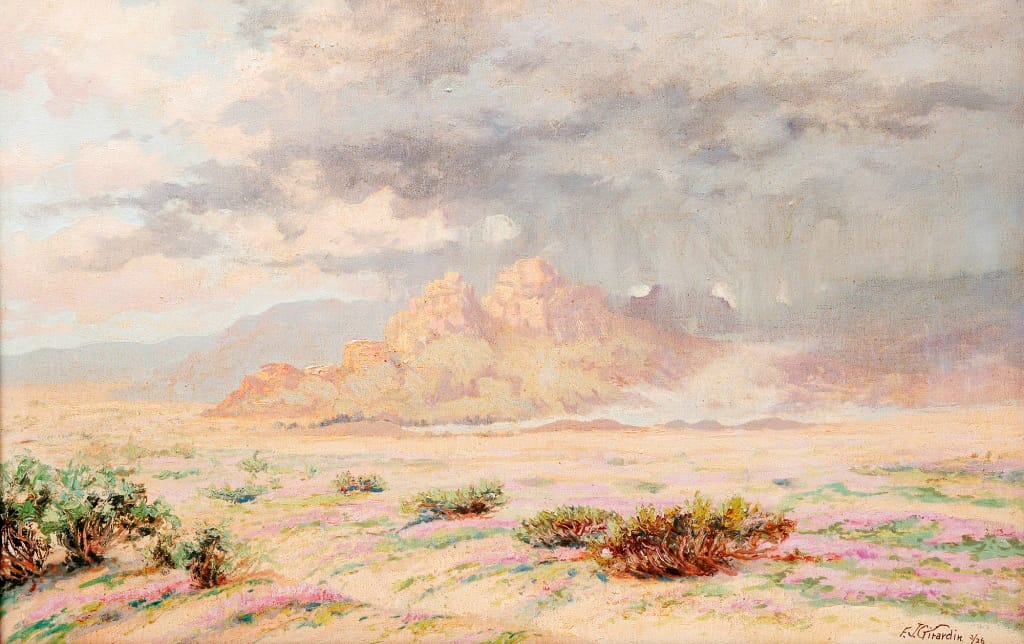
Frank J. Girardin, Desert Landscape (1926), oil on canvas, 20 × 30 inches, private collection.

The Jews spent 40 years in the desert, and so “40” came to signify a time of prayer, preparation and perhaps penance. Moses, Elijah and Jesus all fasted for 40 days, and also in the desert.

The desert became a special place for Israel. Their sojourn in the desert, despite difficulties, was a honeymoon with the Lord. When later Israel became unfaithful, God declared He would allure her into the desert and speak tenderly to her heart, and she would respond to Him as in the days of her youth (Hosea 2:14-15). Today we begin 40 days of Lent, and Jesus invites us to come apart with Him into a desert place and rest awhile (Mk 6:31).

Those who venture into the desert must leave the superfluous behind, travel with the bare necessities and depend on God alone. They must enter its solitude and silence to hear the small still voice of God. They must encounter the demons that are there and those they bring with them, discover their deceptions and resist their temptations as Jesus did. The desert is a place of purification and conversion, but rain from heaven can make even our desert bloom into newness of life.