Reflections on Art from 100 Years Ago

By Fr. Peter Fennessy, SJ

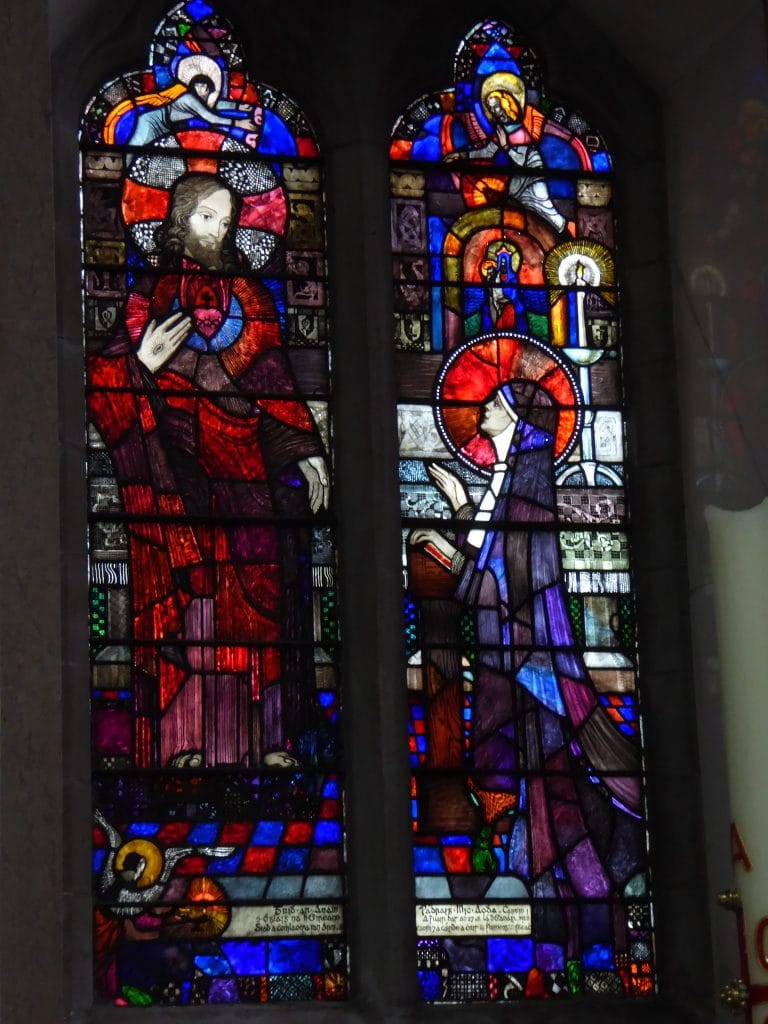
Hubert McGoldrick, (detail) Revelation of The Sacred Heart of Jesus to St. Margaret Mary Alacoque (1925), stained glass window, St. Brendan’s Cathedral, Loughrea, County Galway, Ireland

We celebrate the feast of Saint Margaret Mary Alacoque on October 16 not only because of her holiness of life, but also because of the Lord’s revelations to her of His love for us, illustrated in this stained-glass window.

Those revelations led to our modern devotion to the Sacred Heart and its feast. Pope Pius XI said, “the feast of the Sacred Heart of Jesus was instituted at a time when men were oppressed by the sad and gloomy severity of Jansenism, which had made their hearts grow cold, and shut them out from the love of God and the hope of salvation.” That heresy taught that people were predestined to heaven or hell and could do nothing about it, that most people couldn’t love God enough to be forgiven their sins and were unworthy to receive Communion or its grace.

In apparitions to Margaret Mary between 1673 and 1675 Jesus made clear His love for us and His disappointment—not anger—when we fail to return the love that He so much desires from us. Margaret Mary’s director, St. Claude La Colombière, SJ, and his fellow Jesuits today promote this devotion to the Sacred Heart and oppose any Jansenist denial of it.

stained glass

Reflections on Art from 100 Years Ago

By Fr. Peter Fennessy, SJ

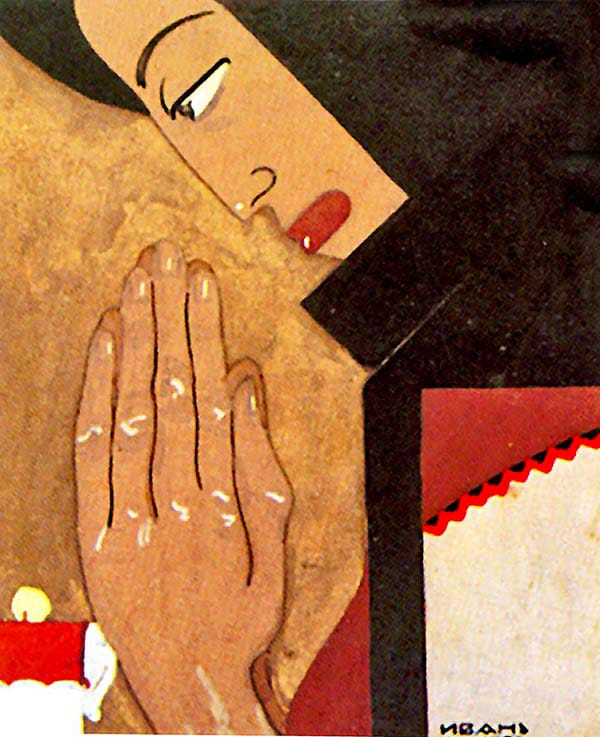
Ivan Milev, Prayer (1925), Iskra Historical Museum, Kazanlak, Bulgaria.

woman praying

Ivan Milev was said to be the first and only artist to paint Bulgarian rural Christians where we can see their souls, customs and hopes. His attention to the poor villagers led him to appreciate their spirituality and prayer.

In his “Evening Prayer in the Field” (1925) two peasants pause, sickles still in their hands, to bow, bless themselves and pray in the midst of their work. In “Prayer” (also 1925) a peasant woman prays before her home icons.  Her pious features are also iconic—geometric, abstract, intimating her unearthly, eternal and spiritual dimension. She has turned away from her daily labors and also from us to be absorbed in her prayer and intent only on the Lord.

She symbolizes and models for us why Manresa Jesuit Retreat House was founded. It is a holy place to which we withdraw from our usual lives. We enter into its silence and the silence of our hearts, the better to hear God’s words and receive God’s graces. It is holy ground where we refresh ourselves, our spiritual energies and our relationship with the Lord, and from which we return again to our usual lives strengthened in the Spirit and more fully ourselves.