
The Ascension of the Lord
By Fr. Peter Fennessy, SJ
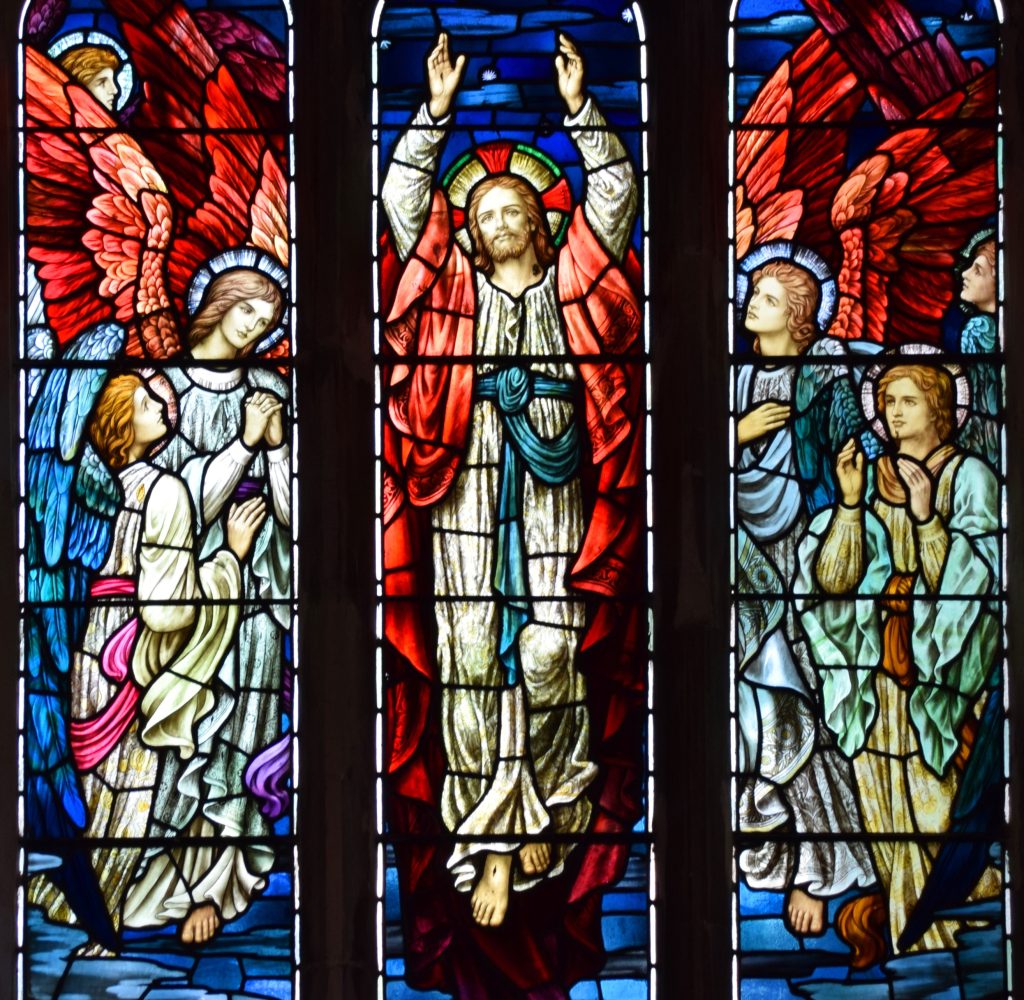
William Glasby, detail of The Ascension of Christ (1926), stained glass, the Church of St. George, Wyverstone, Suffolk, England.
(Photo courtesy of Simon Knott)
Today we celebrate two truths: that Jesus was exalted to the right hand of the Father and that Jesus remains with us forever.
When Scripture says that Christ was “exalted,” it is not referring to spatial movement but to greater honor, glory and power. At the end of Matthew’s Gospel, Christ said, “I am with you always to the end of the age.” Then He presumably vanished as He did after His other appearances.
Luke’s Gospel and his Acts of the Apostles tell the stories respectively of Christ and of His disciples and the early Church. Luke modeled these books on the Old Testament stories of Elijah and his disciple Elisha. Elijah promised Elisha that he would receive his spirit if he witnessed him being taken up into heaven (2 Kings 2:10). So, Luke portrayed the disciples seeing Jesus moving upward toward heaven as a sign that they would receive His Holy Spirit and inherit His mission. Then Luke added, “until a cloud took Him from their sight.” Since the cloud in Scripture is a sign of God’s presence, Luke is saying that Jesus’ ascension is not His going away from us but, as Matthew indicated, His abiding presence with us.
