
Manresa Memos is our in-house newsletter highlighting upcoming programs, events and other opportunities. It is published six times a year and available by mail or email. Subscribe to our mailing list here.
Read this issue
We’re grateful for our generous 100th Anniversary Celebration sponsors!
Manresa Memos is our in-house newsletter highlighting upcoming programs, events and other opportunities. It is published six times a year and available by mail or email. Subscribe to our mailing list here.
Read this issueBy Fr. Peter Fennessy, SJ
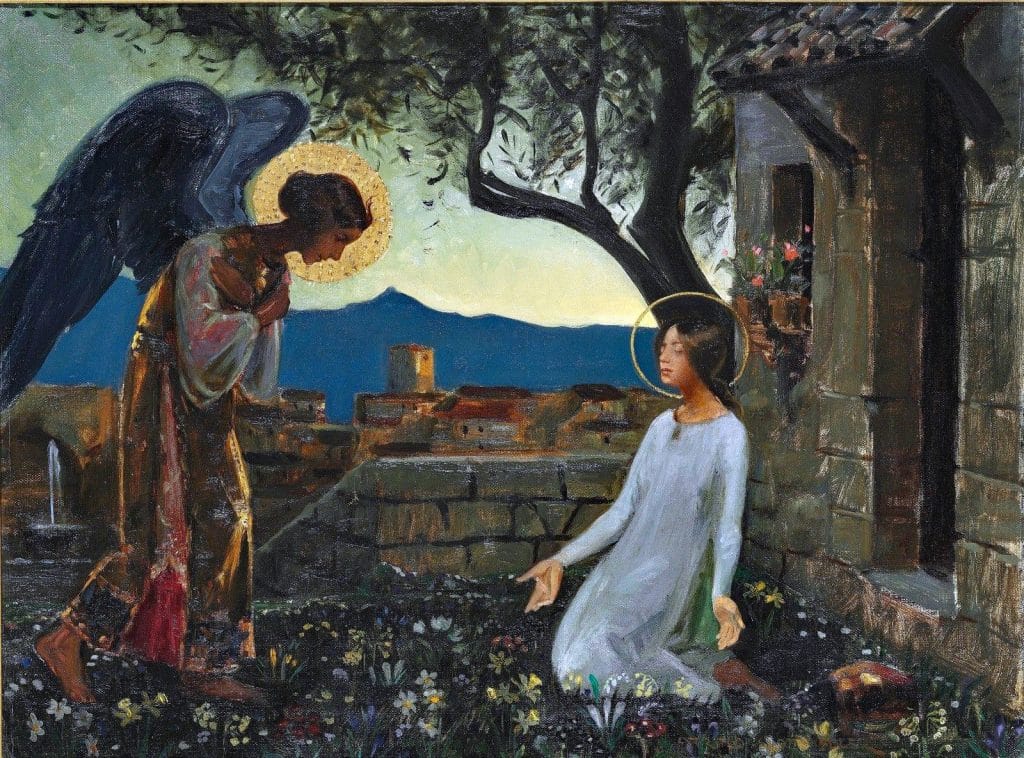
Harald Slott-Møller, The Annunciation of the Virgin Mary (1926), oil on canvas, 19.3 × 25.6 inches, private collection.
We celebrate today the Annunciation to the Virgin Mary (the earliest feast dedicated to her) and the Incarnation of the Lord, since the Word became flesh when Mary gave her consent. The abundant flowers denote new life and fecundity as well as purity. Today’s Gospel tells the story (Luke 1:26-38). And Harald Slott-Møller’s “The Annunciation of the Virgin Mary” (1926) illustrates it.
Painters often depicted Mary regally dressed and in palatial surroundings to stress her dignity, worth and nobility. Here, Mary is a young girl beside a humble home. She’s bare footed and clad in a simple shift. When the angel appeared, she had been doing some household task and, suddenly startled, she dropped a container behind her. The Archangel Gabriel bows to her, his arms are crossed in reverence. She shows what kind of person she is by her posture, facial expression and open arms with which she gives herself totally to God’s will. To become pregnant but not by Joseph could result in divorce, disgrace and even stoning to death. She has ample reason for anxiety and fear. But her response to that is the simple reply: “I am God’s servant. Whatever God wants, my answer is ‘Yes’.”
By Fr. Peter Fennessy, SJ
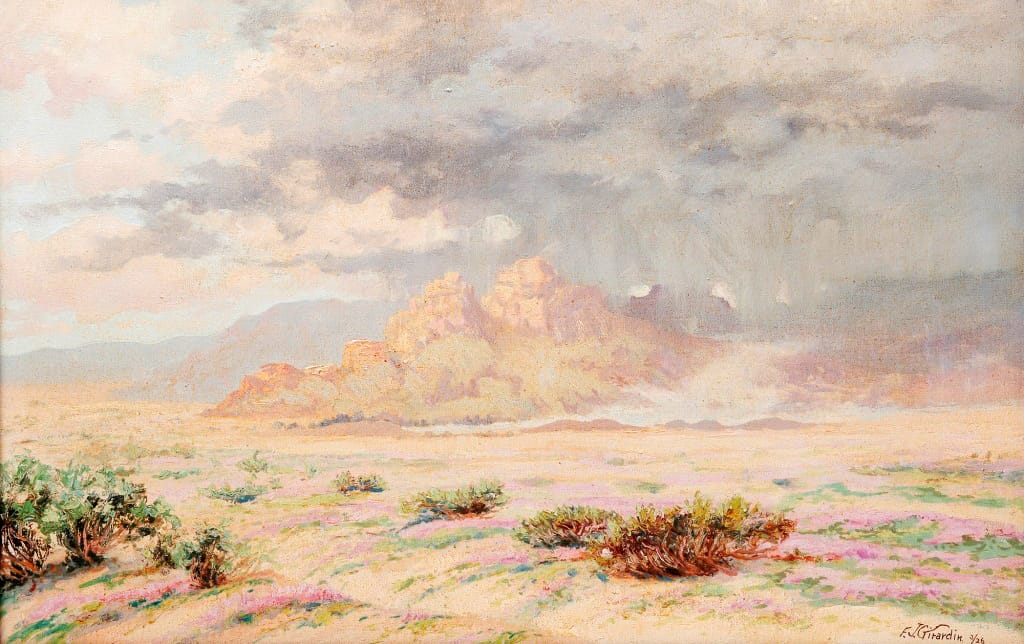
Frank J. Girardin, Desert Landscape (1926), oil on canvas, 20 × 30 inches, private collection.
The Jews spent 40 years in the desert, and so “40” came to signify a time of prayer, preparation and perhaps penance. Moses, Elijah and Jesus all fasted for 40 days, and also in the desert.
The desert became a special place for Israel. Their sojourn in the desert, despite difficulties, was a honeymoon with the Lord. When later Israel became unfaithful, God declared He would allure her into the desert and speak tenderly to her heart, and she would respond to Him as in the days of her youth (Hosea 2:14-15). Today we begin 40 days of Lent, and Jesus invites us to come apart with Him into a desert place and rest awhile (Mk 6:31).
Those who venture into the desert must leave the superfluous behind, travel with the bare necessities and depend on God alone. They must enter its solitude and silence to hear the small still voice of God. They must encounter the demons that are there and those they bring with them, discover their deceptions and resist their temptations as Jesus did. The desert is a place of purification and conversion, but rain from heaven can make even our desert bloom into newness of life.
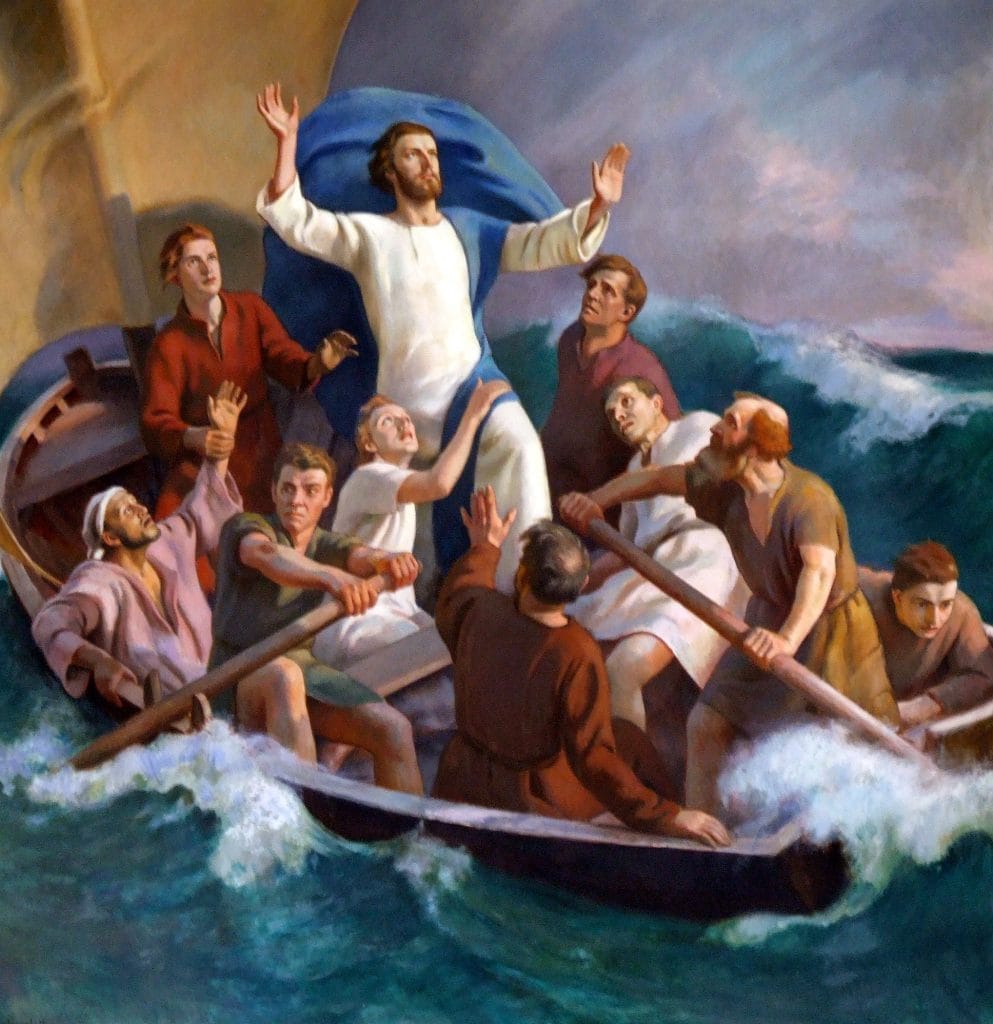
Eero Järnefelt, detail of In a Storm with Jesus (1926), original size 17.7 feet high × 12.1 feet wide, Church of the Holy Trinity, Raahe, Finland.
Today’s Gospel (Mk 4:35-41) tells the story of Jesus calming the storm. Eero Järnefelt’s altarpiece, “In a Storm with Jesus” (1926), portrays the moment when Jesus commands the wind and waves to be still.
The experienced fishermen were in fear for their lives, while the landsman Jesus stayed soundly asleep. They woke Him in their panic. “Didn’t He care that they were perishing?” What could they possibly have expected Him to do? In fact, He did something they could never have expected. Jews believed that only God could command the wind and waves. But Jesus, by doing precisely that and with just a word, proved that He possessed an authority and power reserved for God alone. Well might the awe-struck disciples ask, “Who is this man, that even the wind and the sea obey Him?”
Storms and raging waters are Biblical metaphors for the trials and troubles of life. This story then is a parable about our own struggles and emotional storms, when God seems far away or fast asleep. It invites us to trust that Christ will deliver us by His power from the storms that rage outside or sustain us by His presence from the tempestuous fears within.

Manresa Memos is our in-house newsletter highlighting upcoming programs, events and other opportunities. It is published six times a year and available by mail or email. Subscribe to our mailing list here.
Read this issueBy Fr. Peter Fennessy, SJ
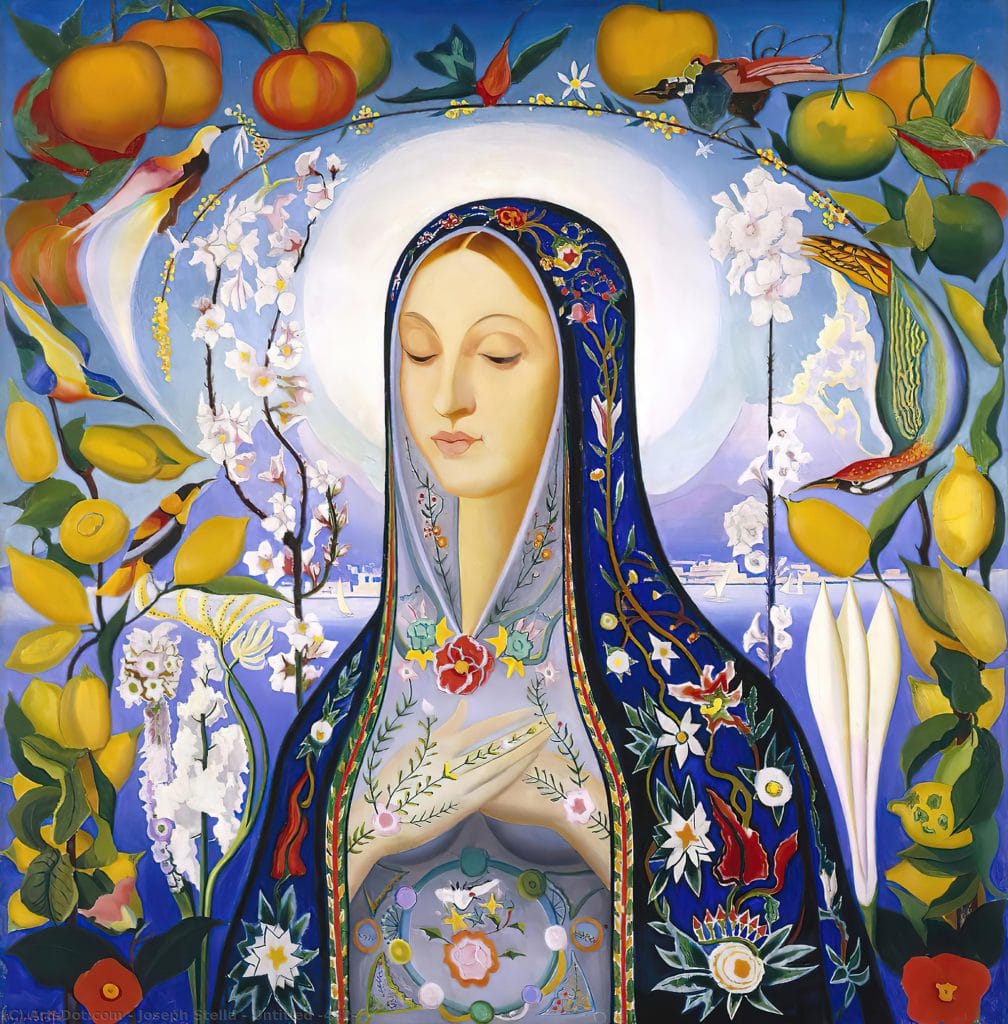
Joseph Stella, The Virgin (1926), oil on canvas, 39.7 × 38.8 inches, Brooklyn Museum.
Joseph Stella became famous for his Cubo-Futurist compositions of New York. But he felt suffocated by the big city and longed for his native Italy. In “The Virgin” (1926) he turned away from urban imagery back to nature, spirituality and the traditions of his homeland.
Behind Mary’s halo Mount Vesuvius rises over the Bay of Naples. The vibrant colors of this painting are those of the ceramics of southern Italy. The Virgin is what he remembered from the Italian Renaissance altarpieces and the religion of his youth. And although the lilies to her left proclaim Mary to be a virgin, she’s surrounded by birds and by Mediterranean fruits and flowers that stand for life, fecundity and fruitfulness. Flowers adorn her mantle, tunic, hands and significantly the circle that in icons of Our Lady of the Sign represents her womb which holds the newly conceived Son of God.
She has become the Mother of God, whose feast we celebrate this first day of the year. Mary’s face shows peace, her lowered eyes humility and prayerfulness, her folded hands acceptance of God’s will and her love of the Child within her. She is a model for us and our mother as well.
The Jesuits and staff are grateful for the many people who give of their time, talent and treasure to support the Mission and ministry of Manresa. On Thursday, Dec. 4, 2025, we celebrated our Volunteers and Benefactors with a special appreciation dinner. Guests enjoyed cocktails and hors d’oeuvres in the lounge, followed by a plated dinner in the dining room. Each guest received a stemless wine glass with Manresa’s 100th Anniversary logo.


By Fr. Peter Fennessy, SJ
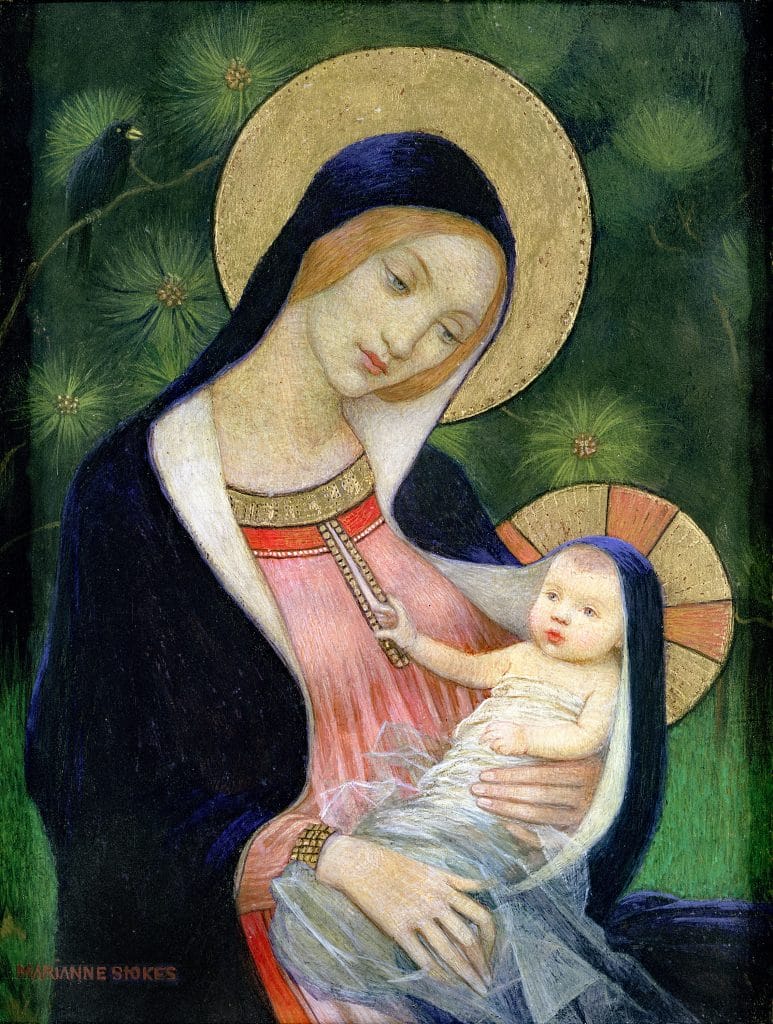
Christmas has come, and in “Madonna of the Fir Tree” by Marianne Stokes, the Virgin proudly shows us her Son, the newborn Savior of the world. His halo bears a cross that alludes to the way in which He will save us. The symbolism in this painting is open to various interpretations. The fir tree is associated with the Christmas tree and so with the birth of Christ. As an evergreen it can represent eternal life and hope. Its strength in storms makes it a symbol of resilience and the ability to overcome adversity. Crows are sometimes seen in combination with symbols of hope or redemption; they manifest the contrast between light and darkness, life and death, despair and salvation. So, this painting might portray the fact that light, hope and eternal life have entered our world of darkness and sin in the person of the newborn Lord. It might refer to the prophecy of Isaiah, “Instead of the thorn shall come up the fir tree” (Isaiah 55:13), the thorn here symbolizing pain, sorrow and suffering that will give place to beauty, fragrance and endless life. Or perhaps it is just a lovely picture of Mary and her newborn Child.
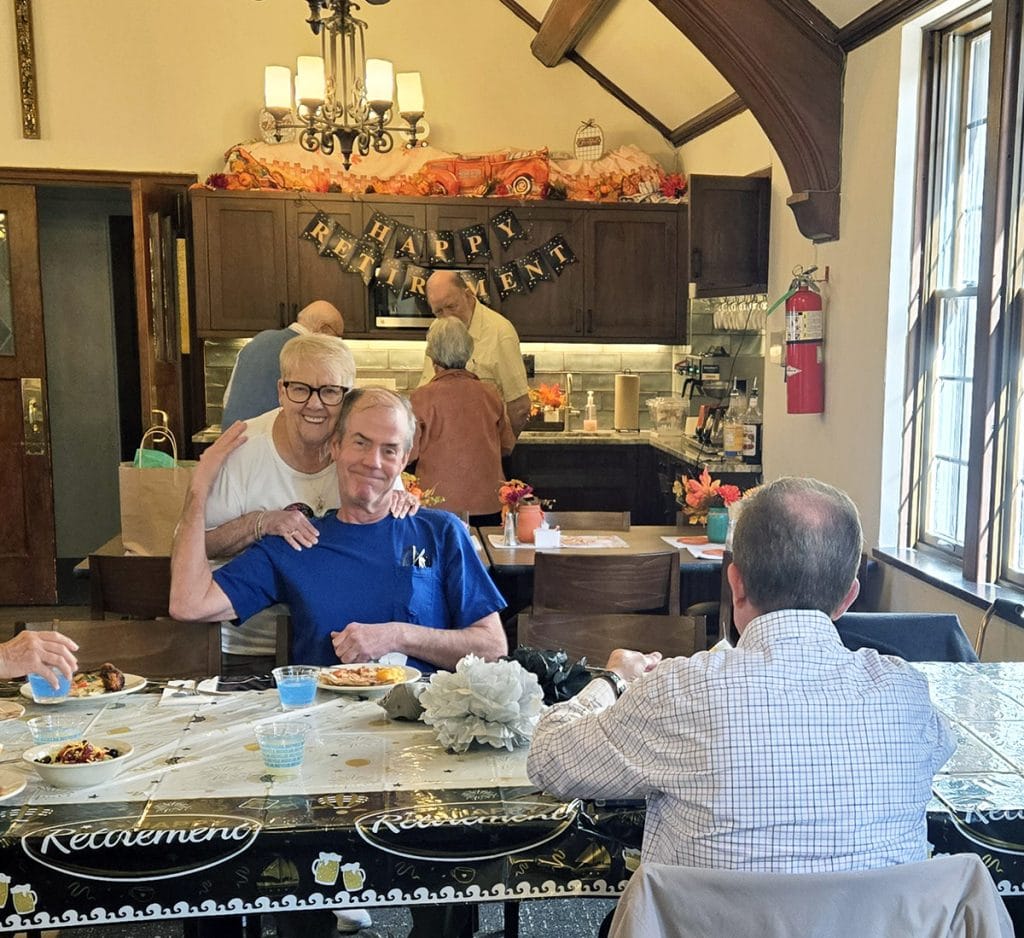
In October, the staff and family of Facilities Manager Pete Luyckx gathered for a luncheon to celebrate his retirement from Manresa. Pete began his 41-year career at Manresa in September 1984, a year after coming on retreat with his father.
“I heard they were looking for someone, and Fr. Simon hired me,” said Pete, who holds the record for the longest serving staff member.
Pete said he stayed as long as he did because the job “offered a steady paycheck and every day’s work was different.”
Though he won’t miss the middle-of-the-night false alarm calls or snow removal each winter, Pete said he will miss the people at Manresa.
“It’s kind of like a family, you know. And I’ll miss the free lunches, of course,” he quipped.
Pete is confident that facilities assistants Leonard Waske and Vito Gill will do a great job of picking up where he leaves off. “The place is in good hands,” he said.
His plans for retirement are to “take it easy, travel up north this winter and maybe travel the country in the spring.” He said he’s also happy to help out at Manresa when needed.
Manresa is grateful for Pete’s faithful service and wishes him all the best in the years to come.



By Fr. Peter Fennessy, SJ

Jennie Augusta Brownscombe, (detail) Thanksgiving at Plymouth (1925), oil on canvas, original 30 × 39.13 inches, National Museum of Women in the Arts, Washington, D.C.
Colonists in New England and Canada regularly celebrated days of prayer and thanksgiving. Jennie Augusta Brownscombe’s “Thanksgiving at Plymouth” depicts Plymouth Colony’s first harvest feast in 1621, often thought to be the origin of our Thanksgiving. Although Native Americans attended this celebration, Brownscombe may have been making a point when she huddled them together so far to the side. Thanksgiving is not a happy feast for Native Americans.
Christians believe gratitude is appropriate every day. Each day at the Eucharist (Greek for “thanksgiving”) most Prefaces begin, “It is truly right and just, our duty and our salvation, always and everywhere to give You thanks, Father most holy, through Your beloved Son, Jesus Christ.” Saint Paul writes, “In all circumstances give thanks, for this is the will of God for you in Christ Jesus” (1 Thessalonians 5:18). Saint Ignatius, in the final Contemplation of his Spiritual Exercises, says that all things around and within us are gifts from God, for which we ought to be grateful. For Ignatius, ingratitude was the greatest of all sins. We should make our own the prayer of Dag Hammarskjöld that begins, “For all that has been—Thanks!”
