
The Good Samaritan
By Fr. Peter Fennessy, SJ
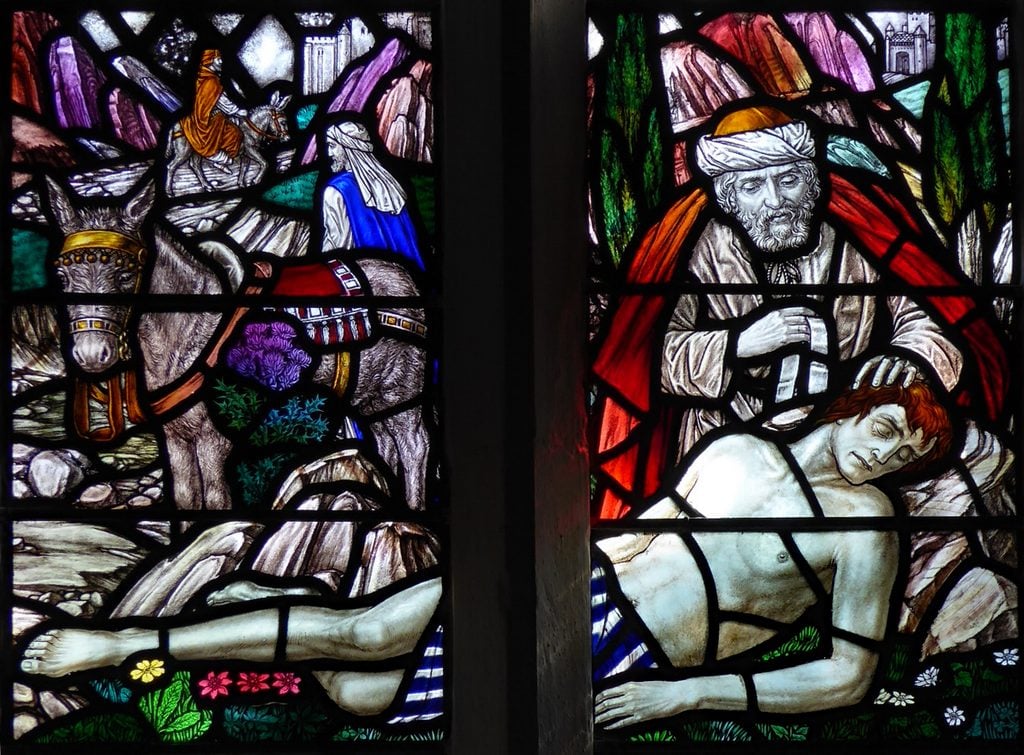
Florence Camm, detail of The Good Samaritan (1926), stained glass window, Saint John the Baptist Church, Strensham, Worcestershire, England.
(Photo courtesy of Aidan McRae Thomson)
(https://www.flickr.com/photos/amthomson/45417621384/in/photostream)
In this stained-glass window of “The Good Samaritan” (1926), the Samaritan is bandaging the victim who sprawls stripped and half-dead on the ground. To the left a priest and a Levite have both gone out of their way to avoid helping the injured man, and the donkey, ready to carry the man to the inn, looks at us and so draws us into the scene. This parable of Jesus (Luke 10:25-37) addresses the lawyer’s question, “If we must love our neighbor, who is our neighbor?” Jesus doesn’t answer questions with statements but with commands. He asks, “Who was a neighbor to the man?” When the lawyer says the one who had mercy on him, Jesus tells him to go and do likewise.
Art often pictures Christ as the Good Samaritan. After Satan and sin have assaulted humanity on the road of life and left us half dead and stripped of God’s supernatural gifts, the Law and its ministers are unable to help us. But Christ does. He heals our wounds with purifying wine and soothing oil that are His sacraments. And then He commits us to the care of St. Peter and his successors at the inn of the Church.
