Reflections on Art from 100 Years Ago

The Good Samaritan

By Fr. Peter Fennessy, SJ
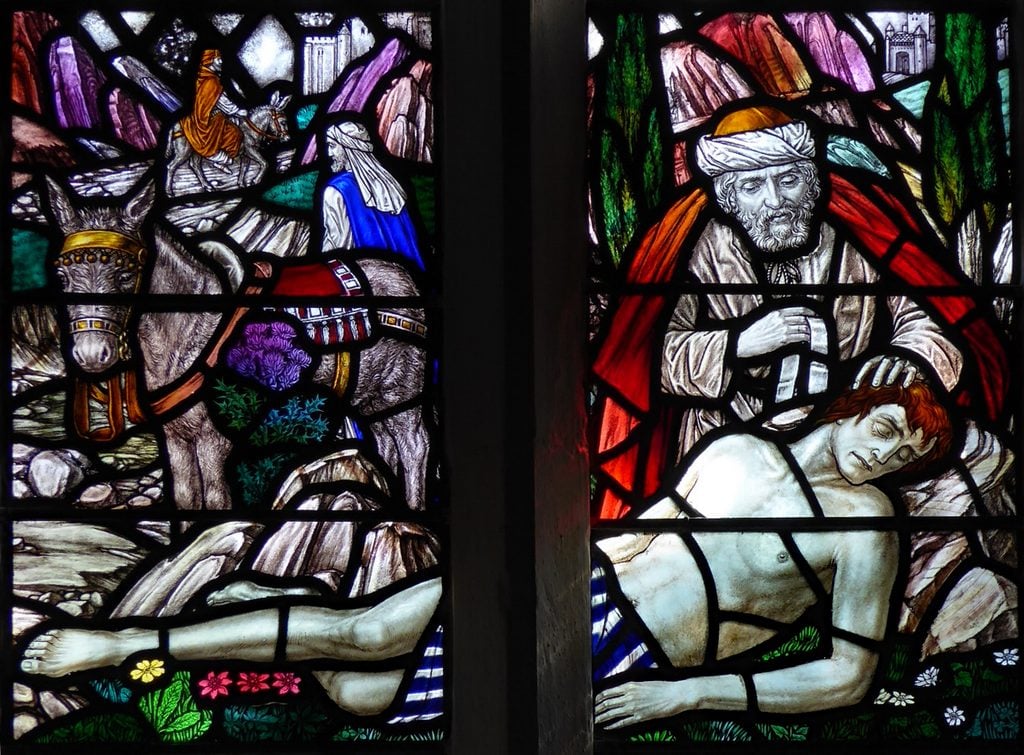
Florence Camm, detail of The Good Samaritan (1926), stained glass window, Saint John the Baptist Church, Strensham, Worcestershire, England.
(Photo courtesy of Aidan McRae Thomson)
(https://www.flickr.com/photos/amthomson/45417621384/in/photostream)

In this stained-glass window of “The Good Samaritan” (1926), the Samaritan is bandaging the victim who sprawls stripped and half-dead on the ground. To the left a priest and a Levite have both gone out of their way to avoid helping the injured man, and the donkey, ready to carry the man to the inn, looks at us and so draws us into the scene. This parable of Jesus (Luke 10:25-37) addresses the lawyer’s question, “If we must love our neighbor, who is our neighbor?” Jesus doesn’t answer questions with statements but with commands. He asks, “Who was a neighbor to the man?” When the lawyer says the one who had mercy on him, Jesus tells him to go and do likewise.

Art often pictures Christ as the Good Samaritan. After Satan and sin have assaulted humanity on the road of life and left us half dead and stripped of God’s supernatural gifts, the Law and its ministers are unable to help us. But Christ does. He heals our wounds with purifying wine and soothing oil that are His sacraments. And then He commits us to the care of St. Peter and his successors at the inn of the Church.
Reflections on Art from 100 Years Ago

St. Francis of Assisi with the Birds

By Fr. Peter Fennessy, SJ

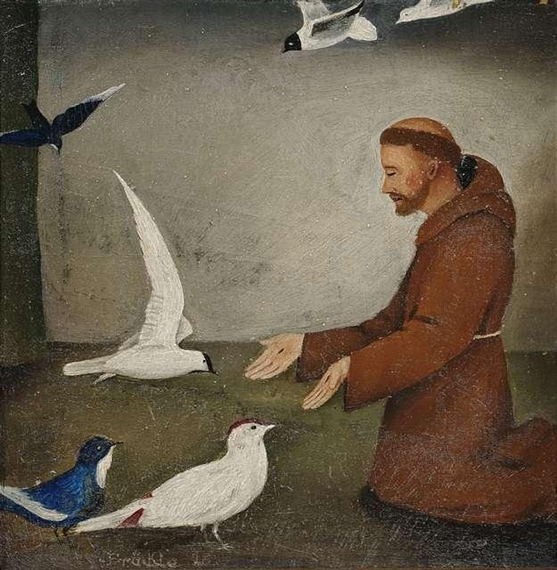
Jakob Bräckle, “Saint Francis of Assisi with the Birds” (1926), oil on cardboard, 10.63 × 9.84 inches.

Over the last three years, the Church and the Franciscan family have celebrated the 800th anniversaries of the approval of the Franciscan Rule (2023), the gift of the Stigmata to Saint Francis (2024) and his composition of “The Canticle of the Creatures” (2025). Today is the 800th anniversary of his death in 1226.

In this painting, Francis kneels humbly, clad in the plain brown habit prescribed by his Rule. His hands show the Stigmata, the wounds he shares with Christ, a gift God gave him in answer to his prayers to be totally united to Christ, especially in his Passion. They are signs of his mystical union with God.

Francis is preaching to the birds, who remind him of Christ’s teaching (Mt 6:26) to trust God’s providence and not to worry about food or clothing. His preaching is an expression of his union with them and with all creatures as our brothers and sisters. We need, with Francis, to respect, love and care for our common home and every living thing in it, and to praise God with them in the wonderful words of his Canticle.

Jakob Bräckle, who painted this picture, was known for the simplicity of his life and his art: quiet scenes of nature, peasant life and faith. This painting, a simple image done on simple material, is appropriate for both the artist and the saint.

Reflections on Art from 100 Years Ago

Christ and the Sinner

By Fr. Peter Fennessy, SJ

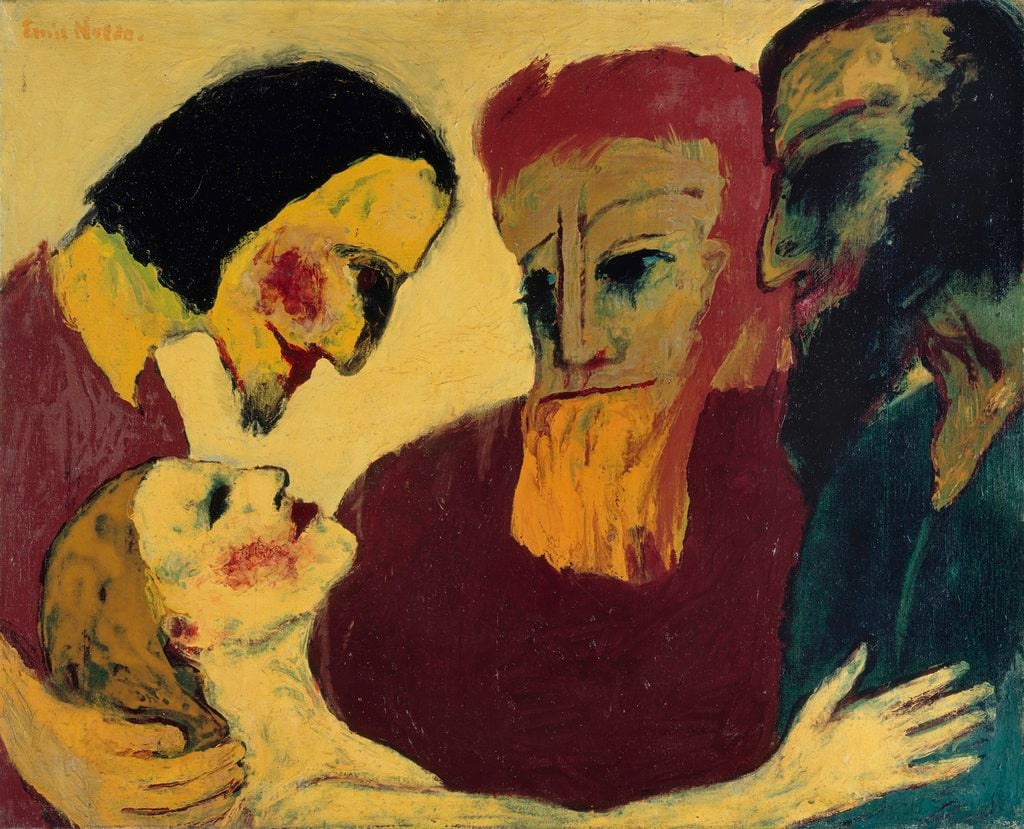
Emil Nolde, Christ and the Sinner (1926),
oil on canvas, 33.9 × 41.8 inches, New National Gallery, Berlin.

Emil Nolde’s bold colors and exaggerated features in “Christ and the Sinner” (1926) add intense emotionality to this painting. The Nazis considered it degenerate; art critics and historians call it Expressionism. It portrays a sinful woman who washed the feet of Jesus or “The Woman Taken in Adultery,” the title of the etching this work was based on. Without a contextual background the reference is ambiguous. Did Nolde use this ambiguity to unite the two stories?

The Pharisees had brought Jesus a woman caught in adultery (John 8:3-11). The Law decreed she should be stoned to death. What did He say? Whether Jesus contradicted the Scriptures or His own constant message of mercy, they had Him. The Law actually said “the couple” should be stoned, but the Pharisees let the man get away, because they had less concern for the Law than for trapping Jesus. Jesus escaped their trap, shamed them into fleeing and didn’t condemn the woman. Later realizing she had been forgiven, she came to Jesus and washed his feet with tears of gratitude (Luke 7:36-50). Christ’ parable of the two debtors clearly indicates the forgiveness had produced her show of love, and not the other way around.