Reflections on Art from 100 Years Ago

The Good Samaritan

By Fr. Peter Fennessy, SJ
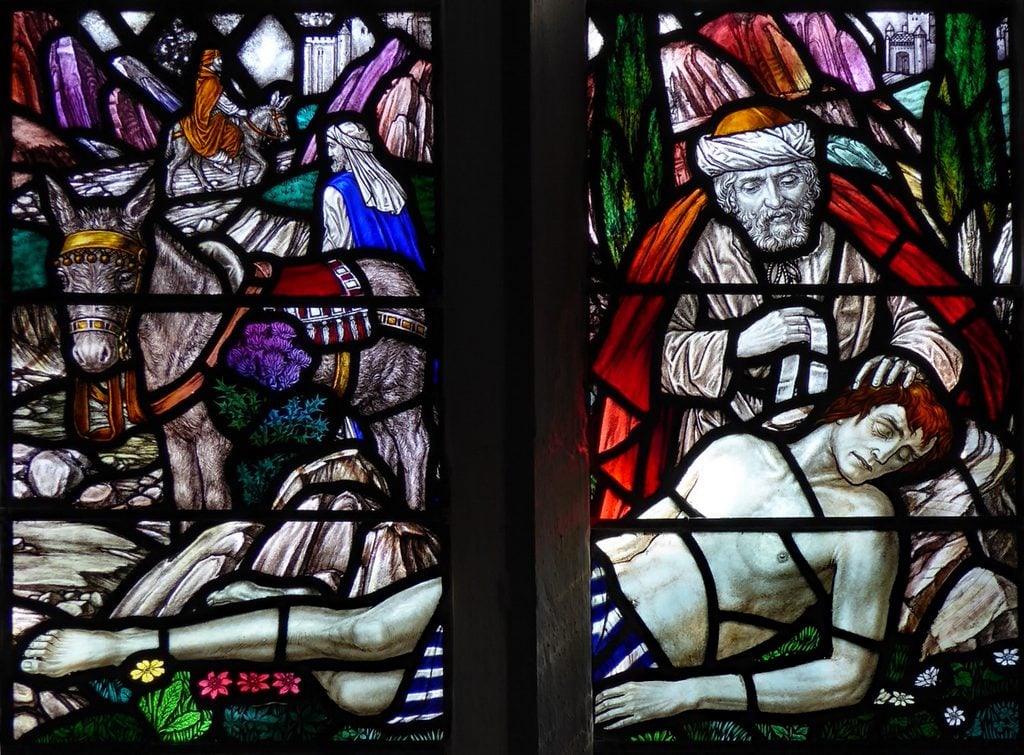
Florence Camm, detail of The Good Samaritan (1926), stained glass window, Saint John the Baptist Church, Strensham, Worcestershire, England.
(Photo courtesy of Aidan McRae Thomson)
(https://www.flickr.com/photos/amthomson/45417621384/in/photostream)

In this stained-glass window of “The Good Samaritan” (1926), the Samaritan is bandaging the victim who sprawls stripped and half-dead on the ground. To the left a priest and a Levite have both gone out of their way to avoid helping the injured man, and the donkey, ready to carry the man to the inn, looks at us and so draws us into the scene. This parable of Jesus (Luke 10:25-37) addresses the lawyer’s question, “If we must love our neighbor, who is our neighbor?” Jesus doesn’t answer questions with statements but with commands. He asks, “Who was a neighbor to the man?” When the lawyer says the one who had mercy on him, Jesus tells him to go and do likewise.

Art often pictures Christ as the Good Samaritan. After Satan and sin have assaulted humanity on the road of life and left us half dead and stripped of God’s supernatural gifts, the Law and its ministers are unable to help us. But Christ does. He heals our wounds with purifying wine and soothing oil that are His sacraments. And then He commits us to the care of St. Peter and his successors at the inn of the Church.
Reflections on Art from 100 Years Ago

St. Francis of Assisi with the Birds

By Fr. Peter Fennessy, SJ

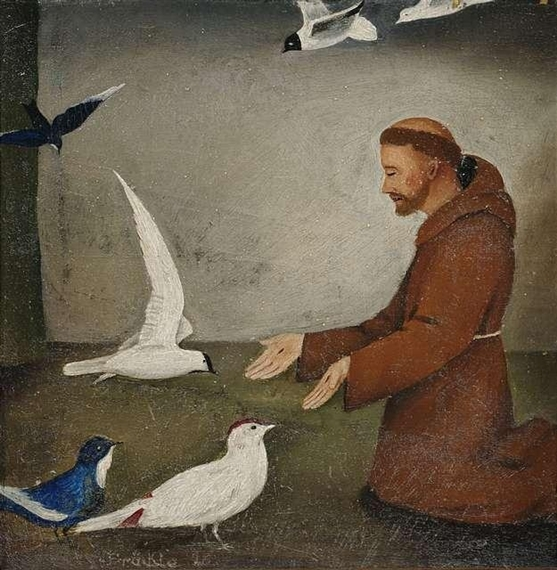
Jakob Bräckle, “Saint Francis of Assisi with the Birds” (1926), oil on cardboard, 10.63 × 9.84 inches.

Over the last three years, the Church and the Franciscan family have celebrated the 800th anniversaries of the approval of the Franciscan Rule (2023), the gift of the Stigmata to Saint Francis (2024) and his composition of “The Canticle of the Creatures” (2025). Today is the 800th anniversary of his death in 1226.

In this painting, Francis kneels humbly, clad in the plain brown habit prescribed by his Rule. His hands show the Stigmata, the wounds he shares with Christ, a gift God gave him in answer to his prayers to be totally united to Christ, especially in his Passion. They are signs of his mystical union with God.

Francis is preaching to the birds, who remind him of Christ’s teaching (Mt 6:26) to trust God’s providence and not to worry about food or clothing. His preaching is an expression of his union with them and with all creatures as our brothers and sisters. We need, with Francis, to respect, love and care for our common home and every living thing in it, and to praise God with them in the wonderful words of his Canticle.

Jakob Bräckle, who painted this picture, was known for the simplicity of his life and his art: quiet scenes of nature, peasant life and faith. This painting, a simple image done on simple material, is appropriate for both the artist and the saint.

Reflections on Art from 100 Years Ago

Christ and the Sinner

By Fr. Peter Fennessy, SJ

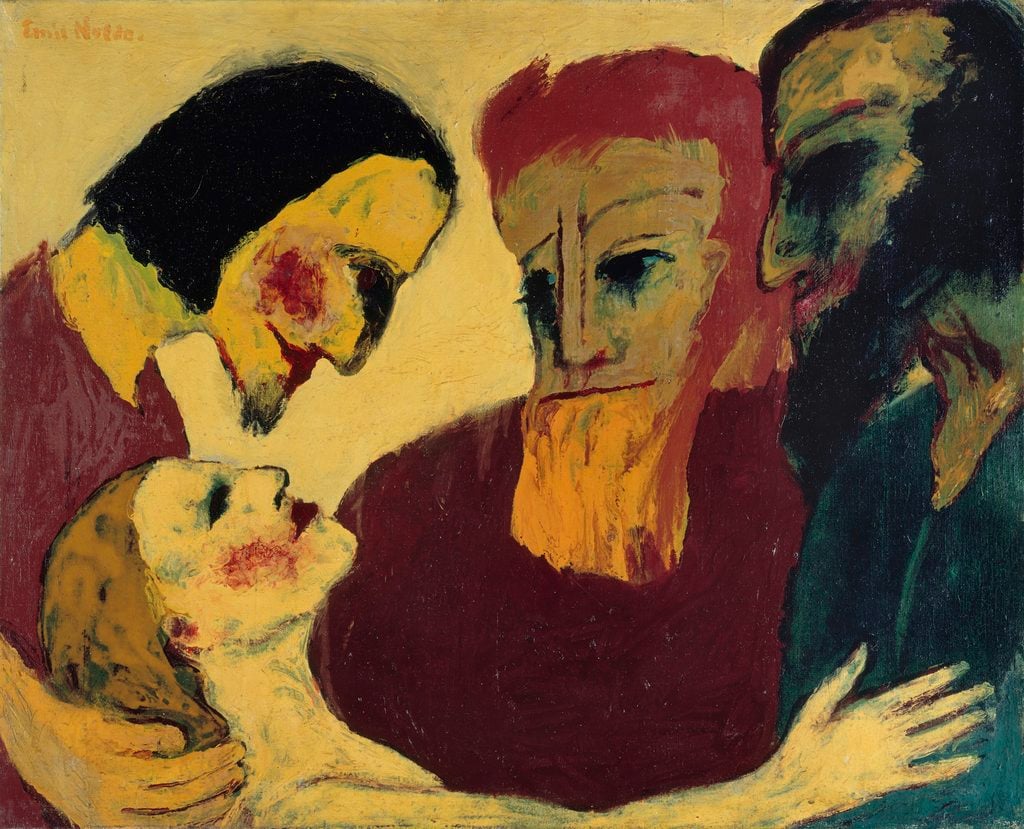
Emil Nolde, Christ and the Sinner (1926),
oil on canvas, 33.9 × 41.8 inches, New National Gallery, Berlin.

Emil Nolde’s bold colors and exaggerated features in “Christ and the Sinner” (1926) add intense emotionality to this painting. The Nazis considered it degenerate; art critics and historians call it Expressionism. It portrays a sinful woman who washed the feet of Jesus or “The Woman Taken in Adultery,” the title of the etching this work was based on. Without a contextual background the reference is ambiguous. Did Nolde use this ambiguity to unite the two stories?

The Pharisees had brought Jesus a woman caught in adultery (John 8:3-11). The Law decreed she should be stoned to death. What did He say? Whether Jesus contradicted the Scriptures or His own constant message of mercy, they had Him. The Law actually said “the couple” should be stoned, but the Pharisees let the man get away, because they had less concern for the Law than for trapping Jesus. Jesus escaped their trap, shamed them into fleeing and didn’t condemn the woman. Later realizing she had been forgiven, she came to Jesus and washed his feet with tears of gratitude (Luke 7:36-50). Christ’ parable of the two debtors clearly indicates the forgiveness had produced her show of love, and not the other way around.

Reflections on Art from 100 Years Ago

The Prodigal Son

By Fr. Peter Fennessy, SJ

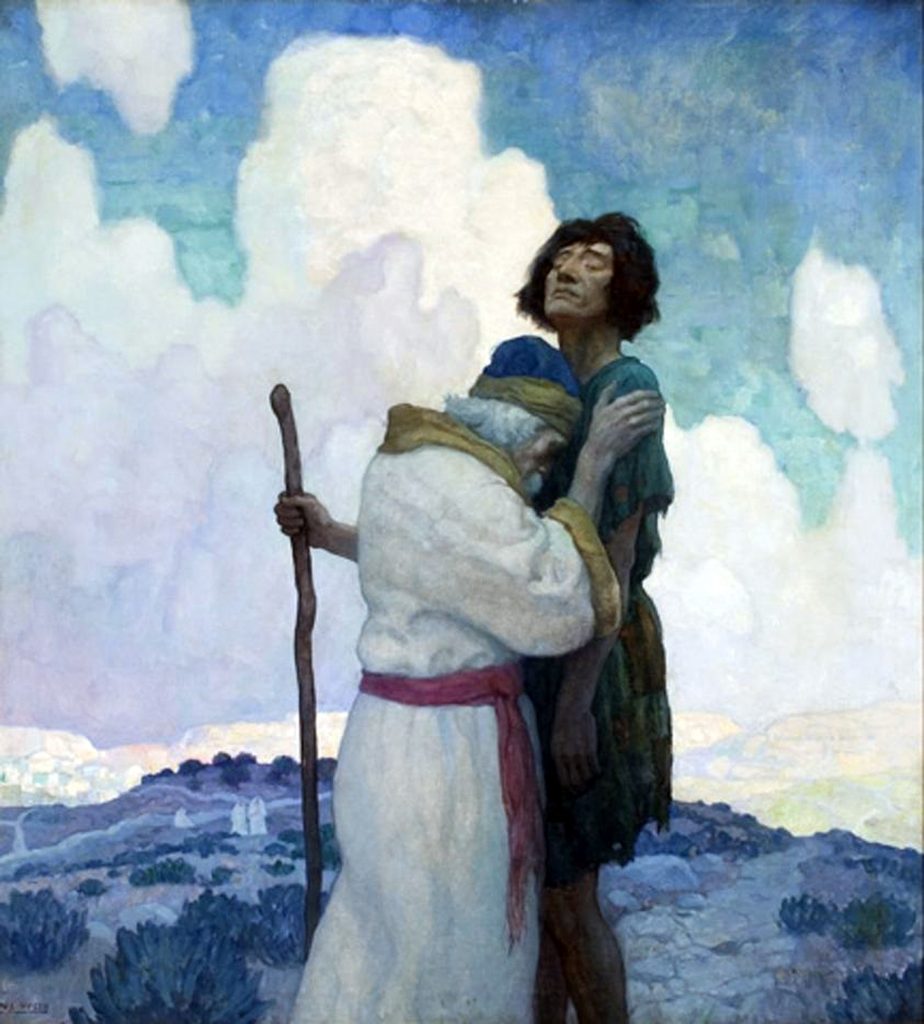
N. C. Wyeth, The Prodigal Son (c. 1926-1927),
oil on canvas, 45 × 40 inches, Kirk in the Hills, Bloomfield Hills, Michigan.

Most paintings of the prodigal son portray him embracing his father or kneeling before him, almost always with a bent head. Wyeth has unusually portrayed him with his head held high and drawn away from his father. One hand holds his walking stick and the other hand hangs by his side. He doesn’t dare return his father’s embrace. His original demand for his inheritance with its implied “wish you were dead” was an unspeakable and unforgiveable offence. His father should have declared him dead, sat shiva for him and even now have sent his servants to drive him away. His repentance arose more from hunger than sorrow, and he’s aware he doesn’t deserve acceptance even as a hired man, paid each day for his daily work, an outsider and less a part of the family than its slaves.

But his father had been watching the road, and seeing his son returning, he threw propriety to the wind, ran to the boy, embraced him and kissed him. The love and mercy, forgiveness and acceptance that the prodigal undeservedly met shamed him more than he can stand. It will take some time for him “to learn to bear the beams of love.”

Reflections on Art from 100 Years Ago

The Sower

By Fr. Peter Fennessy, SJ

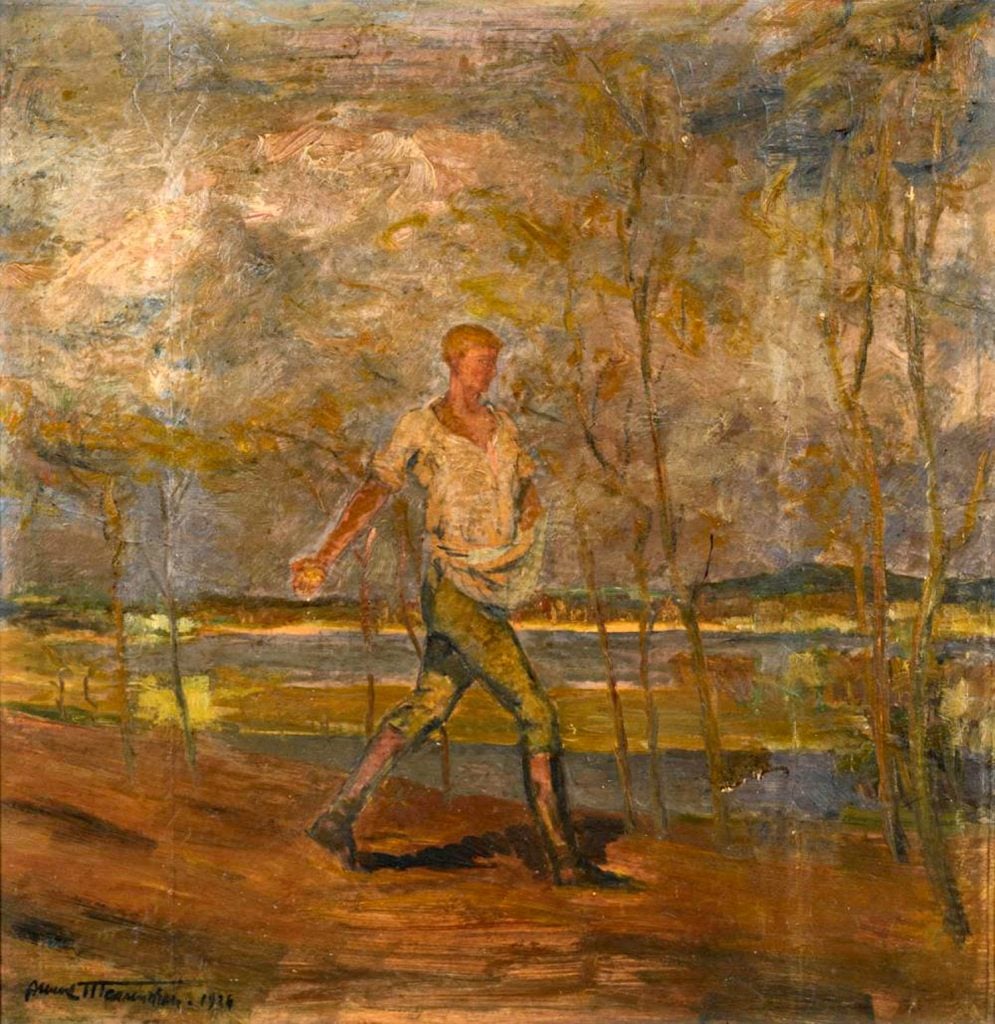
Albert Männchen, The Sower (1926), oil on wood pulp paper, 20.1 × 19.7 inches.

Today’s Gospel (Matthew 13: 1-23) tells the parable of the sower. He strides along sowing seed liberally across future harvest fields. The sower is Christ Who Himself, or through those He sends forth, sows the seed of the Word of God into each of our hearts. The parable is told as if the Word is offered to us only once in our lifetime and we are already and almost permanently one kind of soil that Jesus mentions, either good to various degrees, or vulnerable to dangers that will eventually kill the seed.

But Christ doesn’t pass only once over the patch of ground that is our life. He is always present to us until the end of the ages. Ignatius tells us in his Contemplation to Attain Divine Love that everything around us and within us is a gift of God’s love and a sign of His self-giving.  God reveals Himself to us in each gift and toils in each to make us better soil for His seed. He constantly sends His word into our lives, our minds and our hearts, and on every such occasion, by His grace, we can become more receptive and more responsive to His Word.

Reflections on Art from 100 Years Ago

Feast of the Most Holy Body and Blood of Christ

By Fr. Peter Fennessy, SJ

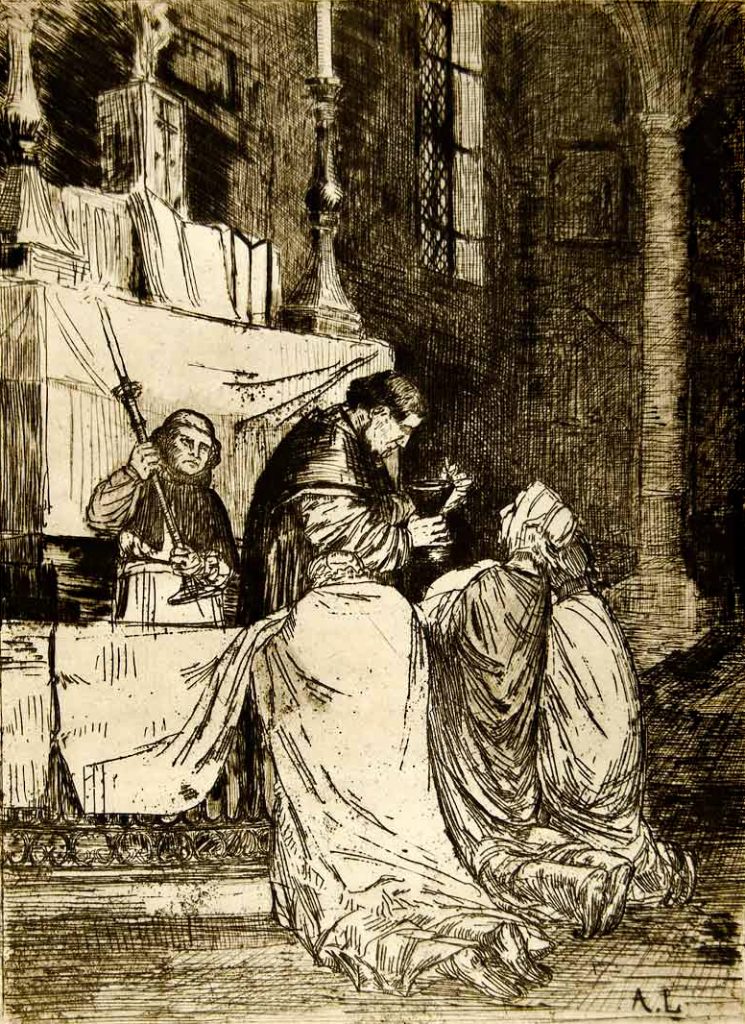
Alphonse Legros, Communion in the Church of Saint-Médard (1926), photogravure, with selvage 8.25 x 11 inches

In 1861 Alphonse Legros produced an etching of Communion being distributed at Saint Médard Church in Paris. It showed a priest lifting the Host before one of only three women communicants. She holds a cloth draped from the altar rail under her chin in case the Host were dropped. An acolyte carries a candle nearby. In 1861 Catholics didn’t receive Communion frequently, often only once a year. But Legros lived to see Pope Pius X issue in 1905 a decree recommending frequent and even daily communion. So, by 1926 when the engraving was reproduced by photogravure the image had acquired a different meaning: what once was rare had now become common.

The institution of the Eucharist is celebrated on Holy Thursday, but so are the Washing of Feet, the Priesthood, the Chrism Mass and the Agony in the Garden. In 1246 individual dioceses began to celebrate Corpus Christi to give the Real Presence of Christ in the Eucharist Its own feast. At the recommendation of Thomas Aquinas Pope Urban IV extended the celebration to the entire Catholic Church. It is now celebrated on the Sunday after Trinity Sunday as the Solemnity of The Most Holy Body and Blood of Christ.

Reflections on Art from 100 Years Ago

The Ascension of the Lord

By Fr. Peter Fennessy, SJ

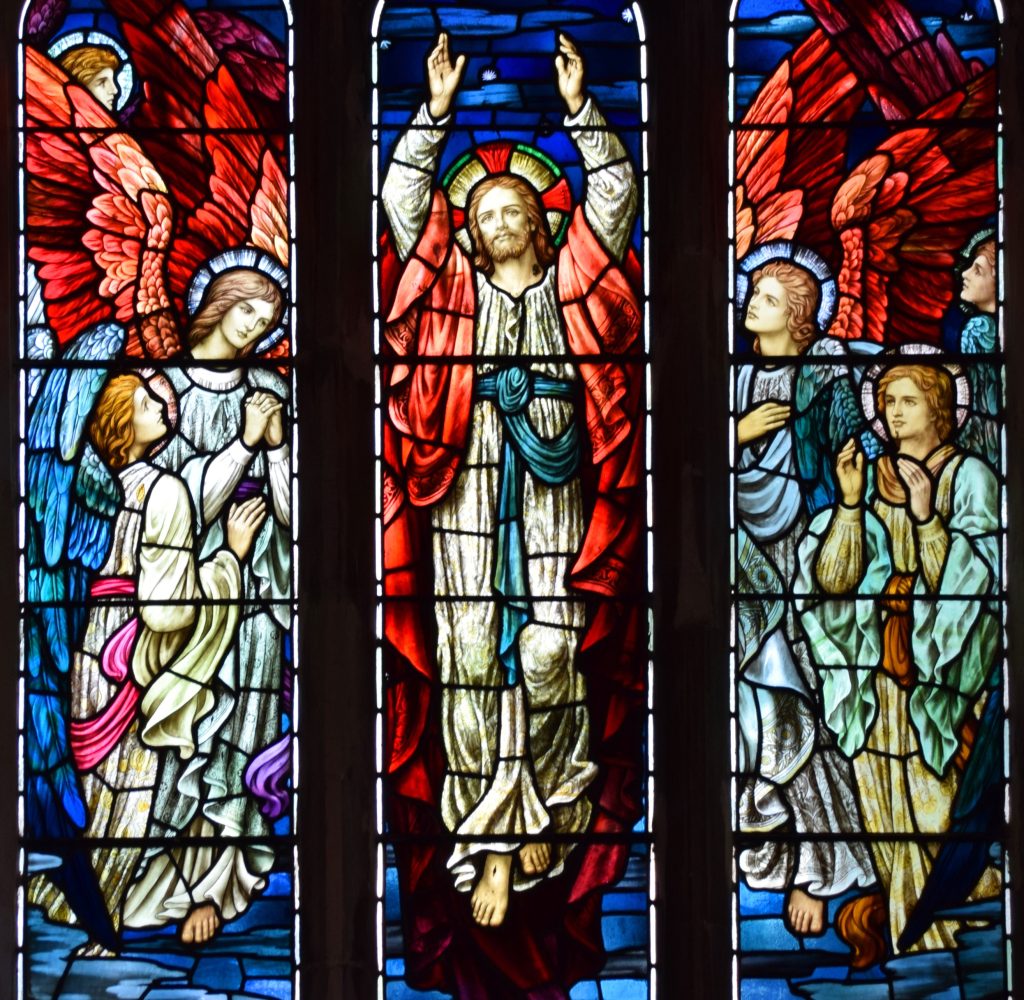
William Glasby, detail of The Ascension of Christ (1926), stained glass, the Church of St. George, Wyverstone, Suffolk, England.
(Photo courtesy of Simon Knott)

Today we celebrate two truths: that Jesus was exalted to the right hand of the Father and that Jesus remains with us forever.

When Scripture says that Christ was “exalted,” it is not referring to spatial movement but to greater honor, glory and power. At the end of Matthew’s Gospel, Christ said, “I am with you always to the end of the age.” Then He presumably vanished as He did after His other appearances.

Luke’s Gospel and his Acts of the Apostles tell the stories respectively of Christ and of His disciples and the early Church. Luke modeled these books on the Old Testament stories of Elijah and his disciple Elisha. Elijah promised Elisha that he would receive his spirit if he witnessed him being taken up into heaven (2 Kings 2:10). So, Luke portrayed the disciples seeing Jesus moving upward toward heaven as a sign that they would receive His Holy Spirit and inherit His mission. Then Luke added, “until a cloud took Him from their sight.” Since the cloud in Scripture is a sign of God’s presence, Luke is saying that Jesus’ ascension is not His going away from us but, as Matthew indicated, His abiding presence with us.

100th Anniversary Celebration Banquet

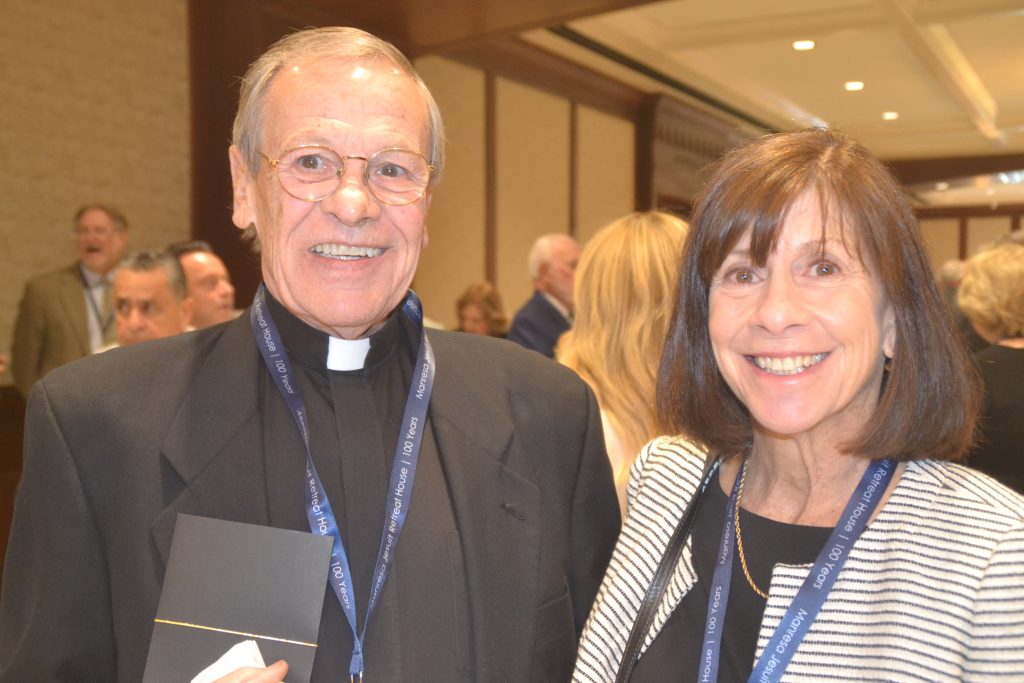
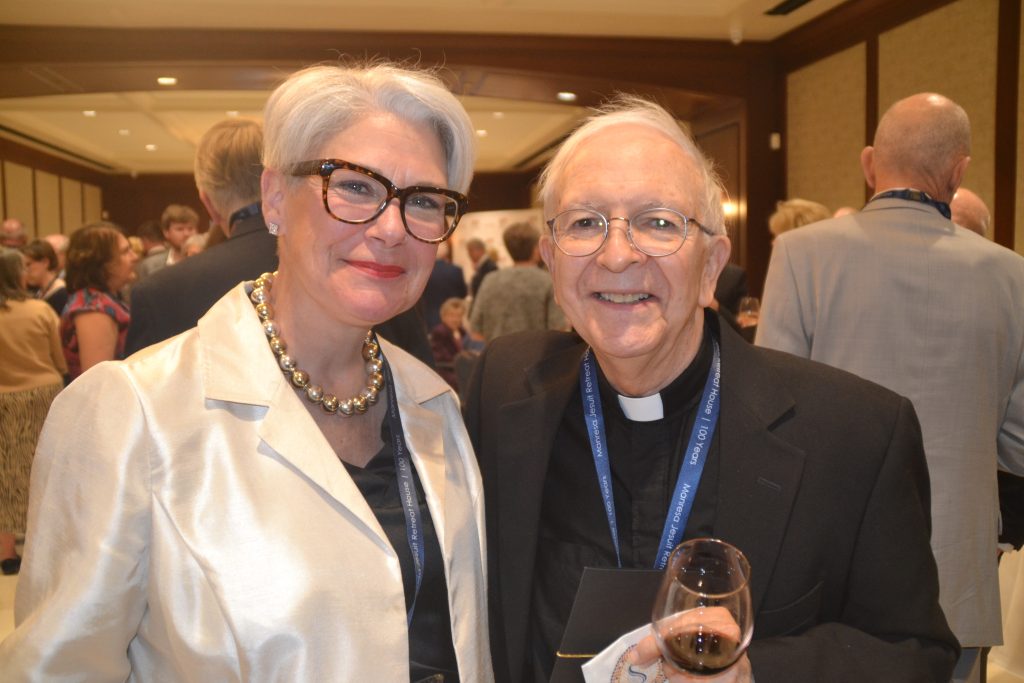
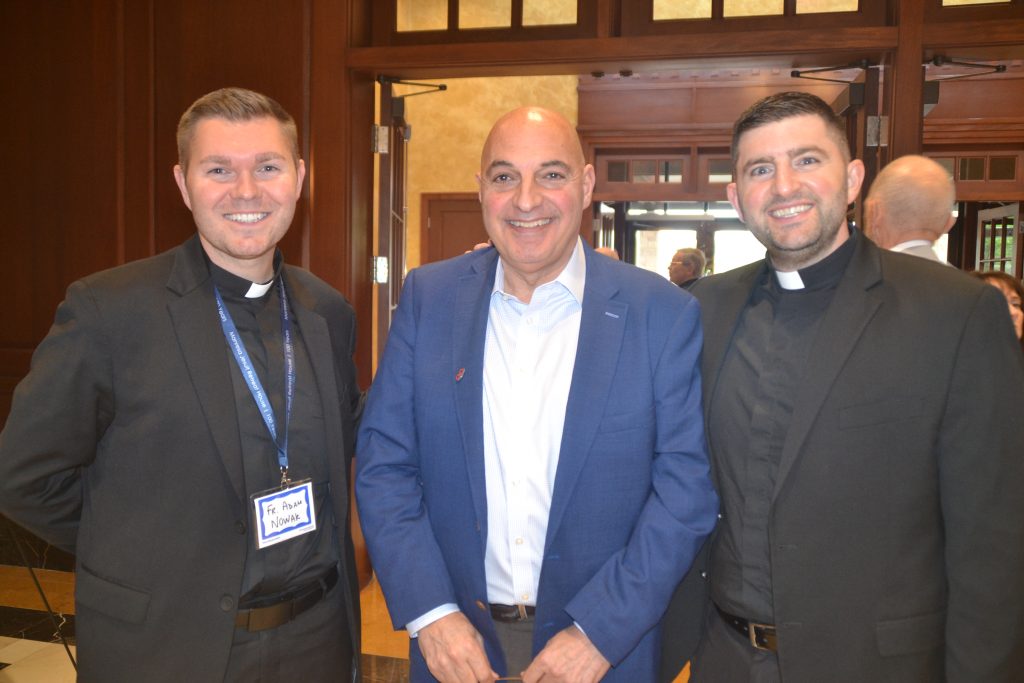
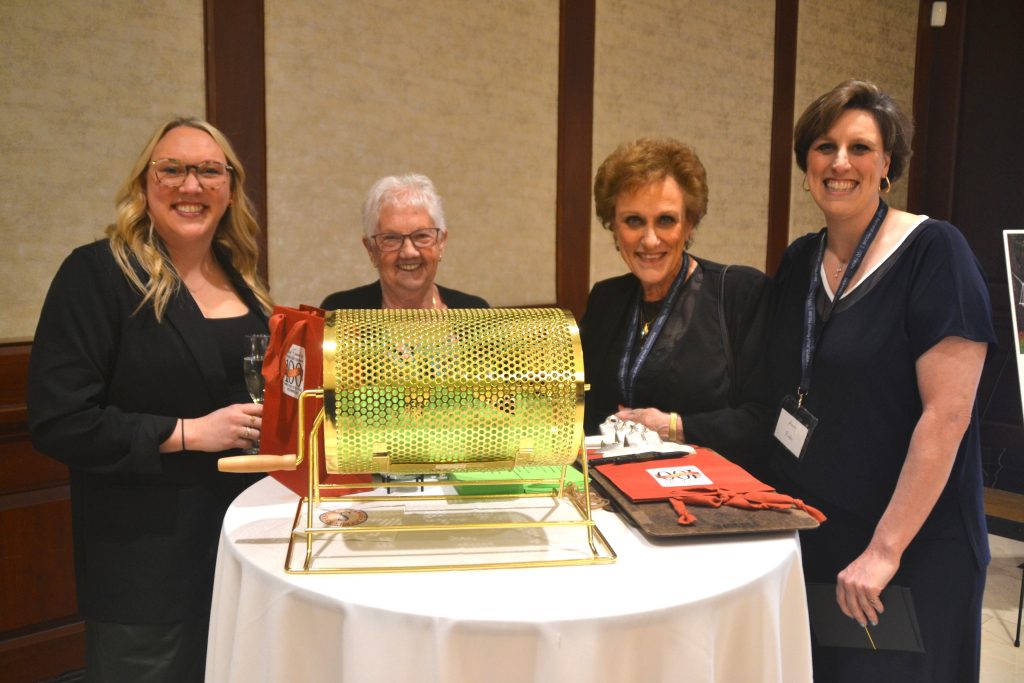
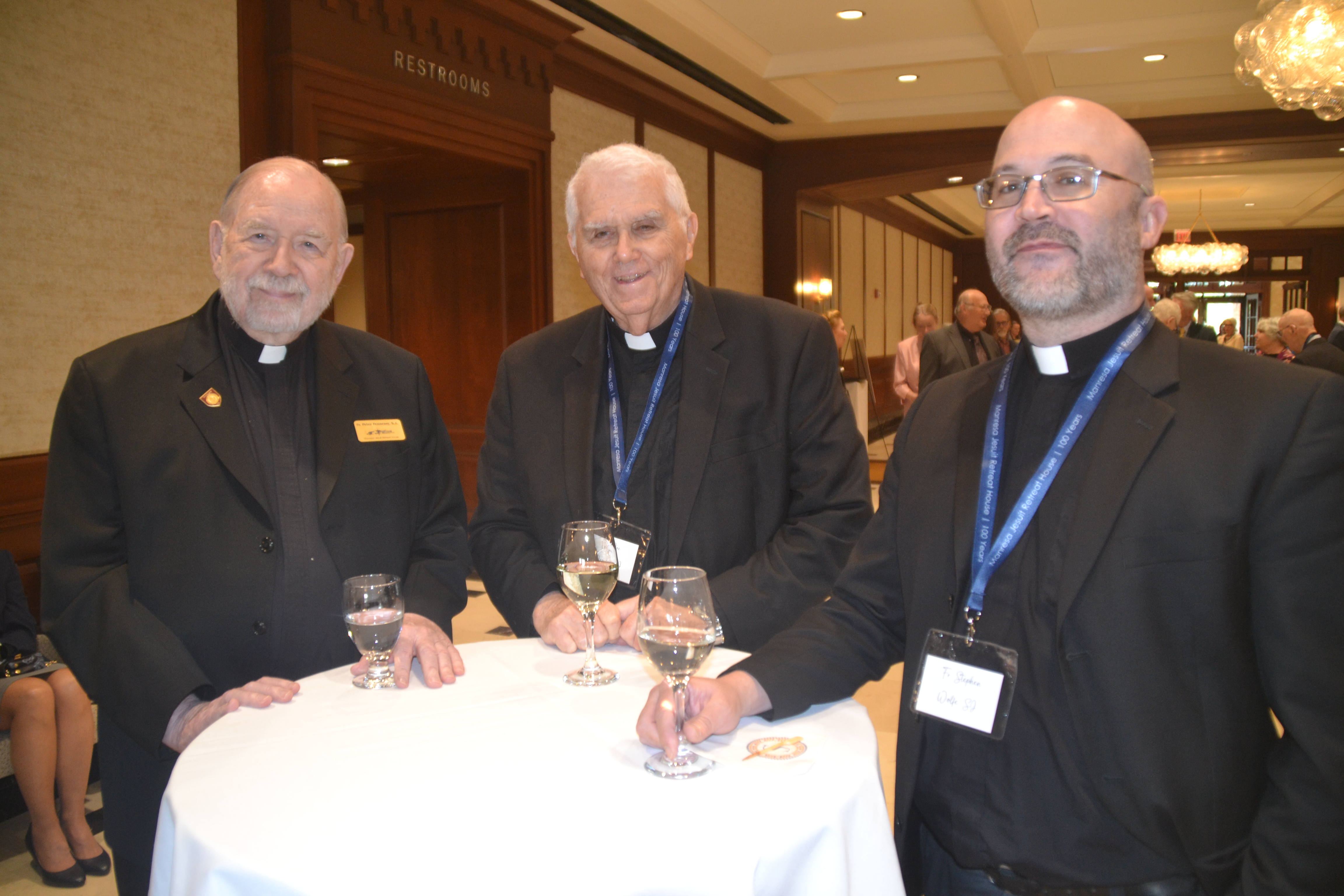
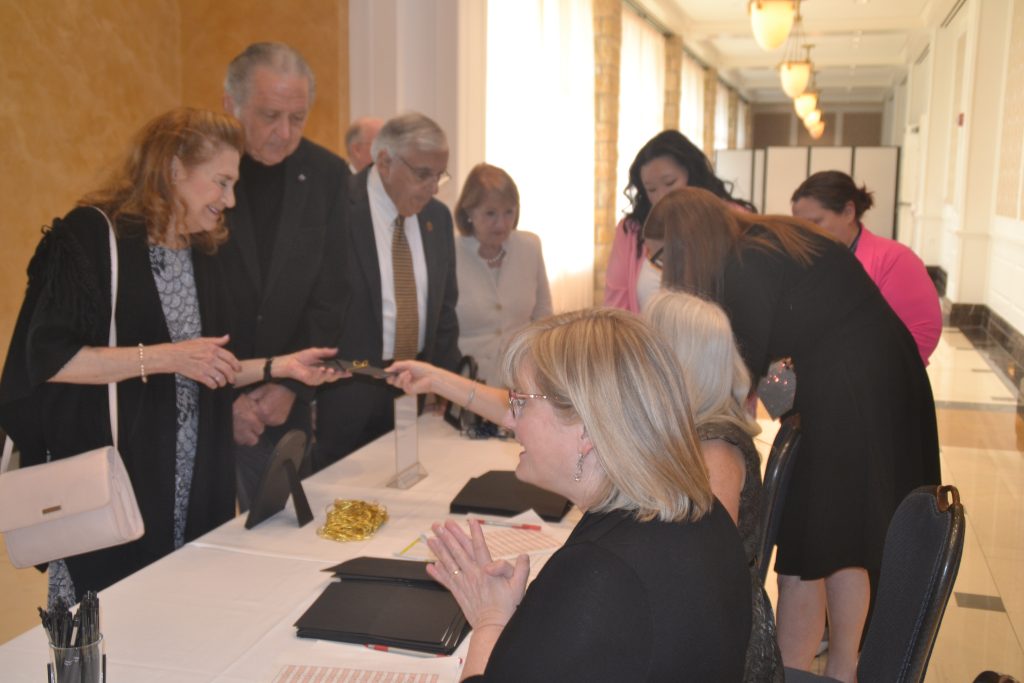
We are so grateful to all those who helped to make Manresa’s 100th Anniversary Celebration Banquet on Thursday, May 7, 2026, at Shenandoah Country Club a wonderful evening.

From the lively social hour in the foyer with tasty hors d’oeuvres to the elegantly appointed banquet hall with a delicious dinner and inspiring speakers, it was a night to remember. More than 270 guests were in attendance.

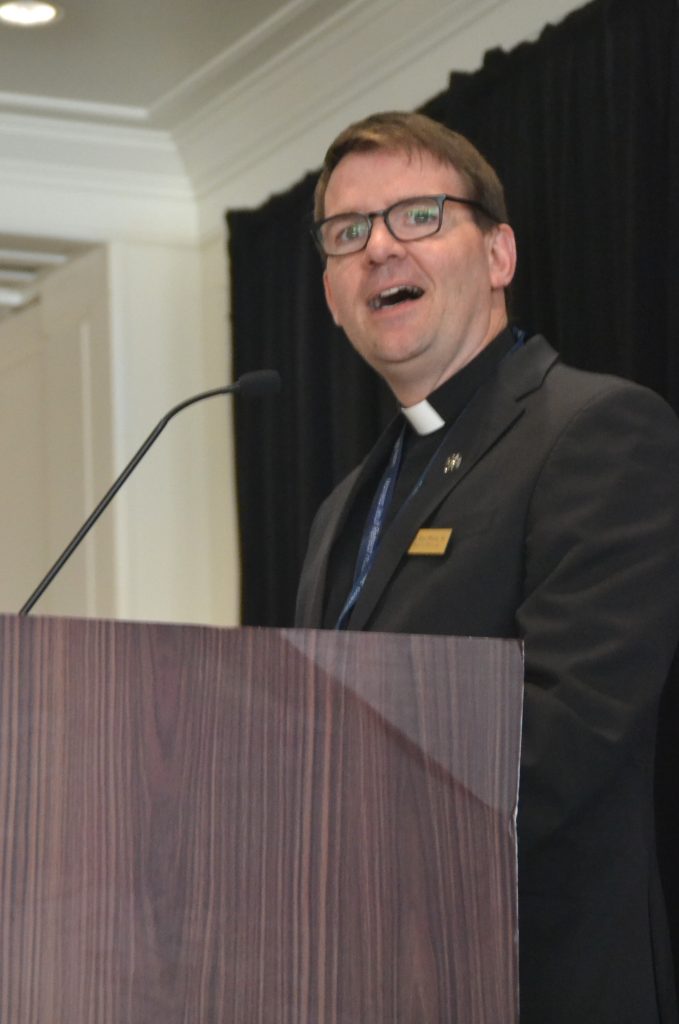
Fr. Dan Dixon, SJ, President Elect, University of Detroit Jesuit High School and Academy, spoke about the many ways Manresa has been an anchor in his life, and Archbishop of Detroit Edward J. Weisenburger inspired us with his message, Building a Future Full of Hope. Guests were also the first to see our latest promotional video (below), A Fire That Kindles Other Fires, produced by Canton-based Highway Media.

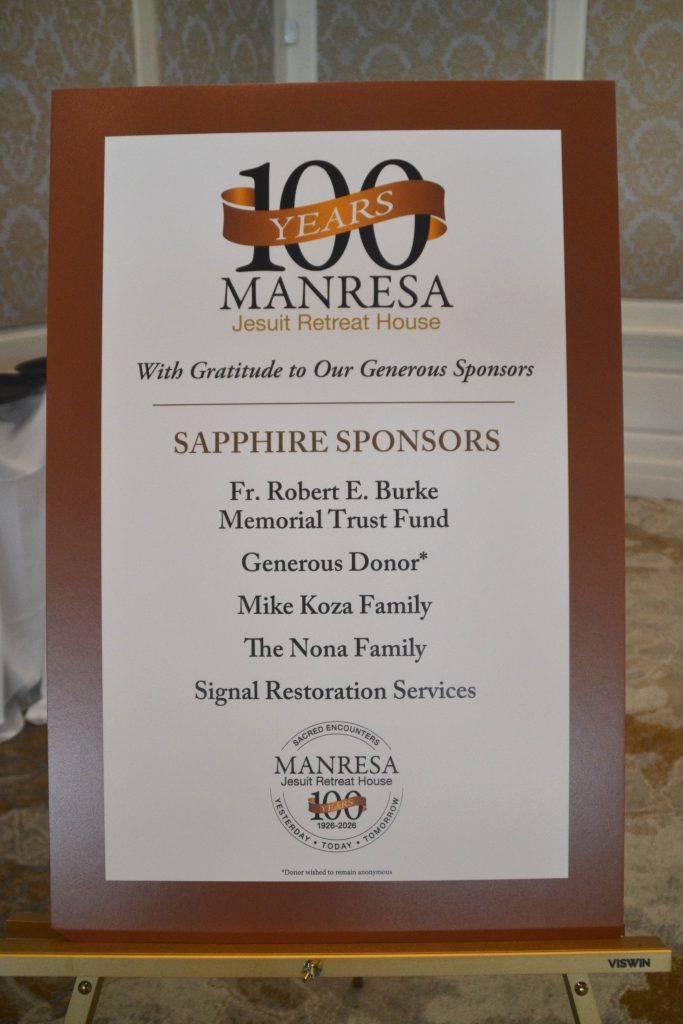
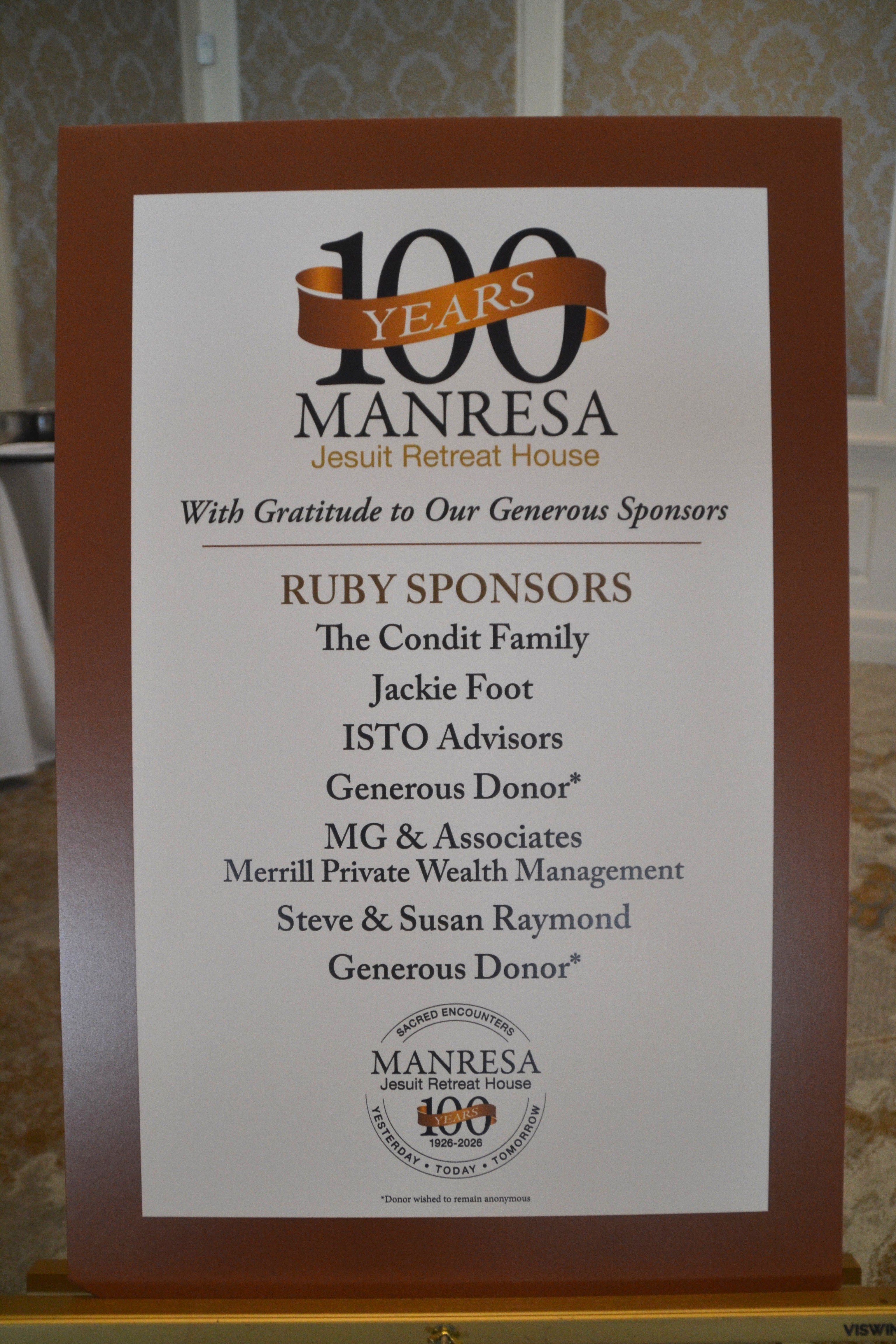
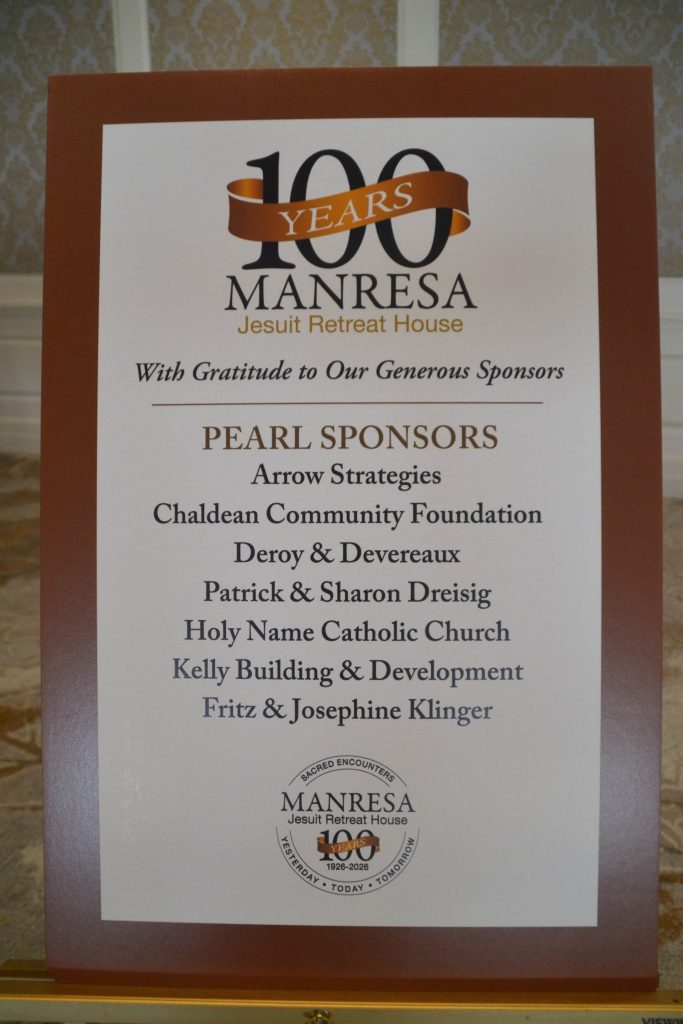
Thanks to our very generous sponsors, we had raised $376,000 before the banquet. They include Presenting Sponsor: E. William & France Kenyon Foundation; Sapphire Sponsors: The Nona Family, The Mike Koza Family, Fr. Robert E. Burke Memorial Trust Fund, Signal Restoration Services; Ruby Sponsors: Steve & Susan Raymond, ISTO Advisors, The Condit Family, Jackie Foot, MG & Associates-Merrill Private Wealth Management, Kelly Building & Development; Pearl Sponsors: Chaldean Community Foundation, Arrow Strategies. Patrick & Sharon Dreisig, Fritz & Josephine Klinger, Deroy & Devereaux, Holy Name Catholic Church; as well several generous donors who chose to remain anonymous.

And thanks to our guests that evening, we raised another $29,150, exceeding our goal of $400,000. All glory be to God!

Our annual banquet is one of our biggest fundraisers, enabling us to meet our operating expenses and to complete necessary maintenance projects and capital improvements throughout the year.

Our sincere thanks to all who make it possible to serve our retreatants and fulfill our Mission to help people grow spiritually through the Ignatian tradition. We also want to thank Paul Seibold and Anne Smith for their photographs of the event, and a special thanks to Chase Creative for their AV management of our program.

If you were unable to join us there, you can still make your Annual Banquet donation at manresa-sj.org/donate or by phoning the front office during business hours at 248.644.4933 Ext. 0.

Reflections on Art from 100 Years Ago

The Lost Sheep

By Fr. Peter Fennessy, SJ

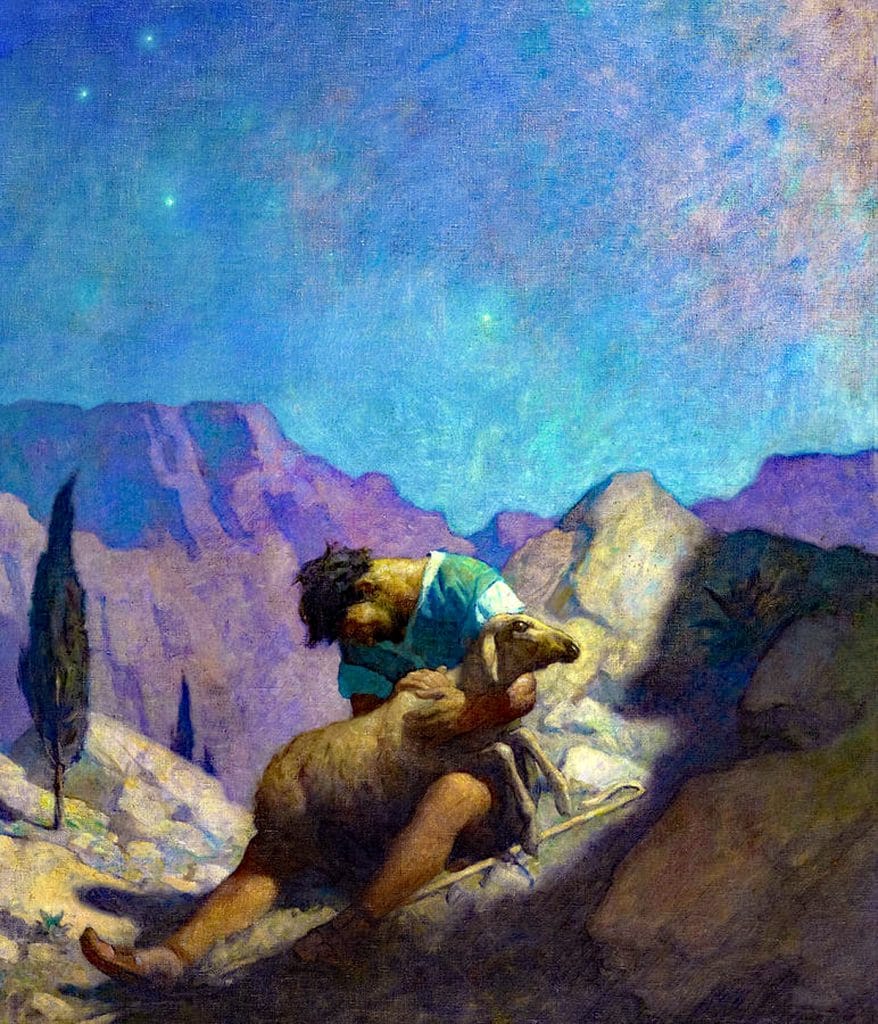
N. C. Wyeth, The Lost Sheep (c. 1926), oil on canvas, 45 × 40 inches, Colby College Museum of Art, Waterville, Maine.

The Pharisees complained so much that Jesus associated and ate with sinners, that He told them the parable of the lost sheep. The terrain is rugged and barren. There are no green pastures or still waters here. The steeply descending treetops hint at the precipitousness of the land.

God, the kings of Israel and the Pharaohs all adopted the title Shepherd since like shepherds they protected, guided, loved and cared for those entrusted to them. Shepherds knew their sheep well enough to notice if even one was missing out of a hundred. But Pharisees despised shepherds as unclean. They must have resented Jesus for beginning this parable, “What man of you…,” as if any of them would ever debase and defile himself by shepherding sheep. But Jesus said that He and heaven rejoiced over a recovered sinner as a shepherd would over a recovered lost sheep. Notice the love and relief of this shepherd tenderly embracing his wayward sheep.

If the three stars in the sky are the Summer Triangle, then morning is breaking, and the light and shadows are from the rising sun; the artist may have believed that the search for the sheep took place mostly at night.